
Episode 04
Denzel, Pasta & Music

Educators in Medicine,
In this newsletter, we continue our journey through the fundamentals of AI, its applications in medicine, and its transformative role in faculty development and education. Let’s jump into learning.
1. AI 101 - A Primer on Artificial Intelligence
Last episode, we learned about what AI is through discussing the basic types of AI. Next, I want to discuss with you the basics of HOW these tools work. The basics of the large language models (LLMs) should be clarified for us to take full advantage of these tools.
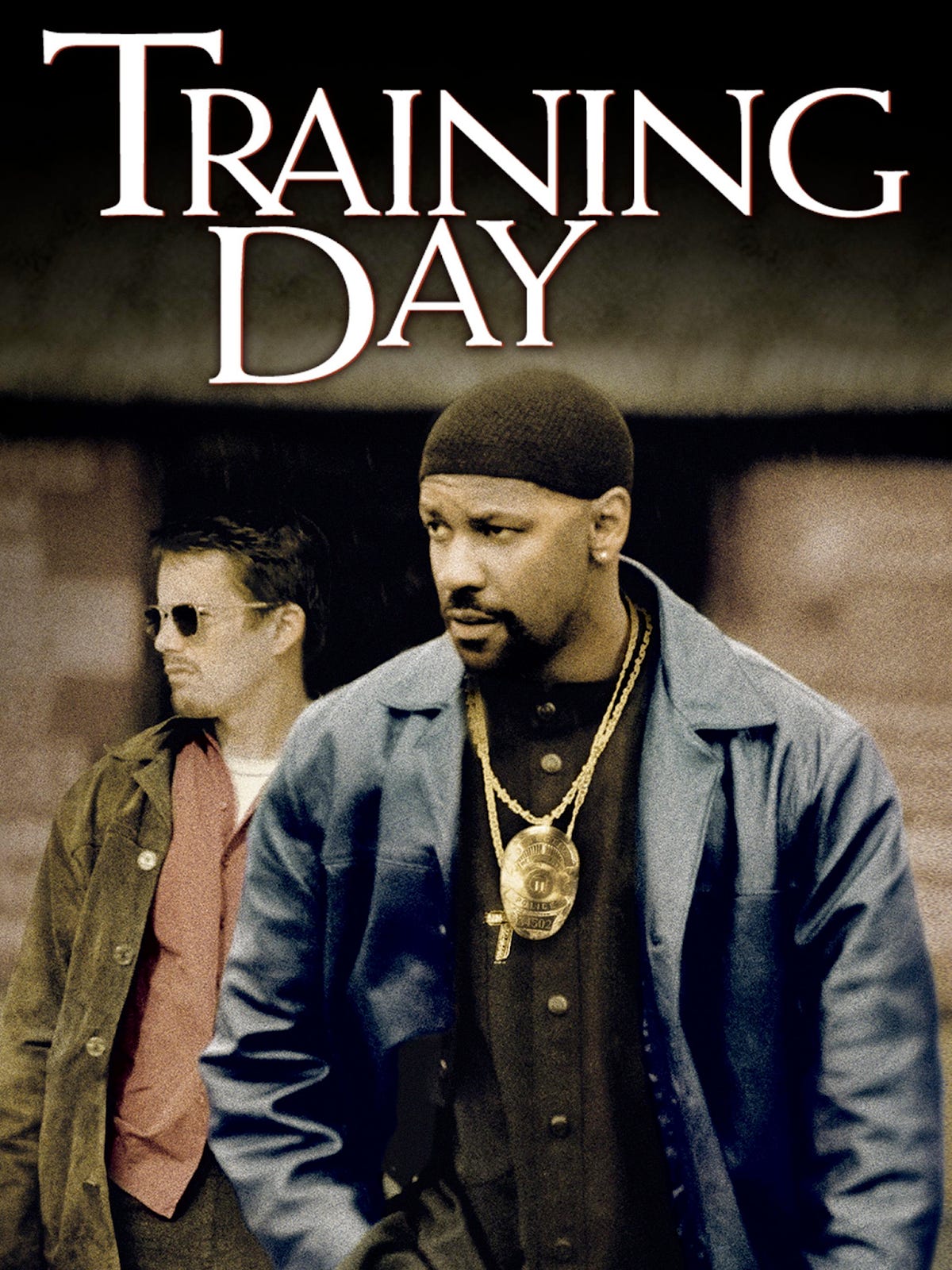
So, as a physician, I should know that ChatGPT is an LLM. This is a type of artificial intelligence designed to understand and generate human-like text based on the vast amount of information it has been trained on. There’s a large body of information collected at a certain time point and can be accessed by the LLM. Think of this information as its past experiences that it can pull from. But “pulling” is not a big deal - like a simple Ctrl+F search function! However, these LLMs can use their information and abstract from them. As a big Denzel fan, the movie Training Day comes to mind. Any on the job training is equipping you to build a repertoire of experiences. They will not repeat exactly, but will give you a skillset from which to pull depending on future scenarios.
Vocabulary and Contextual Understanding
Another way to think of an LLM is like a super-smart dictionary combined with an encyclopedia. Just as a dictionary lists words and their meanings, an LLM has a massive vocabulary stored in its digital brain. But it doesn't stop there; it's not just about knowing words - it understands how they fit together in sentences and paragraphs. Now, it's not really human, so even the word ‘understands’ I struggle with. But it utilizes statistics to decide what words are most likely to fit together, in what order, and in what context.
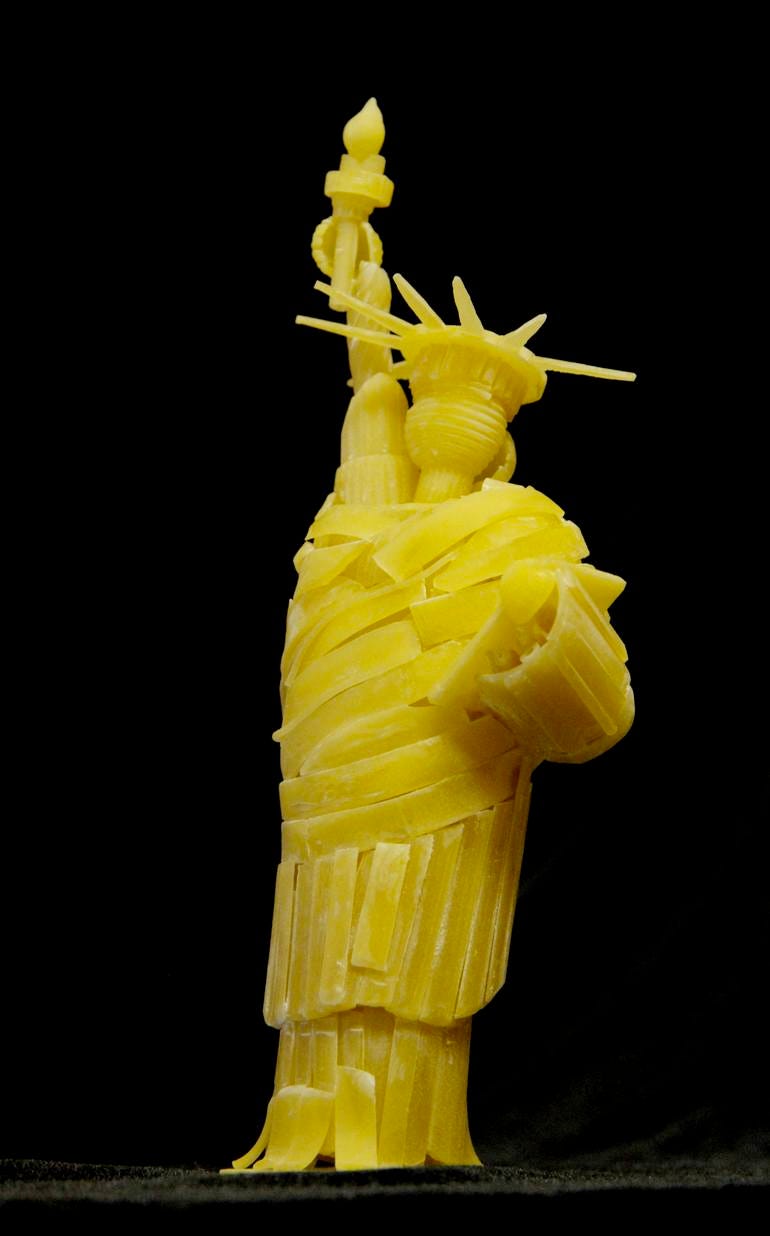
For example, imagine you're typing a sentence about cooking: "I want to make spaghetti." An LLM doesn't just recognize individual words like "I," "want," "make," and "spaghetti." It understands the relationship between these words and can predict that you're talking about cooking a spaghetti dish, not building a spaghetti sculpture.
2. AI in Education - Empowering Faculty Development
As a musician, I like to create - but on my own terms, for my personal enjoyment. My grandfather said that if everyone did their work as a musician creating their music, the world would be a more beautiful place. His focus here was on creating meaningful art, with the end of blissful enjoyment in mind that transcends!
As educators we’re also asked to create, but this is based often on an identified problem and needs assessment, especially if you’re familiar with Dr. Kern’s famous 6 steps of curricular development (which you certainly should familiarize yourself with if you aren't already!). This creation is different from music, and admittedly can be daunting.
I’ve recently been tasked with building a new faculty development curriculum for our department. We’re building on our GME presence with a second residency program, and we decided we needed some focused FD for this program to prosper. I wondered, how could I employ AI to help me build? When asking ChatGPT to help, you really must have the end in mind. What is the final product going to look like? So, I provided ChatGPT with a list of topics I wanted it to build a curriculum around, and then provided an example of what I'd hoped for from each topic. For each topic, I wanted two session titles, each with three learning objectives based on higher-level Bloom’s taxonomy, and a small outline with a group activity in each. The specificity of the prompt took time, but the product was great to see come together. If interested, please reach out to me here and I'd be more than happy to share the PDF! It’s a solid starting curriculum, certainly applicable across specialties. For more reading, check this article out. I found the prompt examples at the end helpful.
To be clear, it was not yet the final product. The work needed editing, cleaning up and tailoring to our needs, but the cognitive burden of the initial step was alleviated by the LLM. AI will not replace us, but makes our time far more efficient.
3. What can I do now?
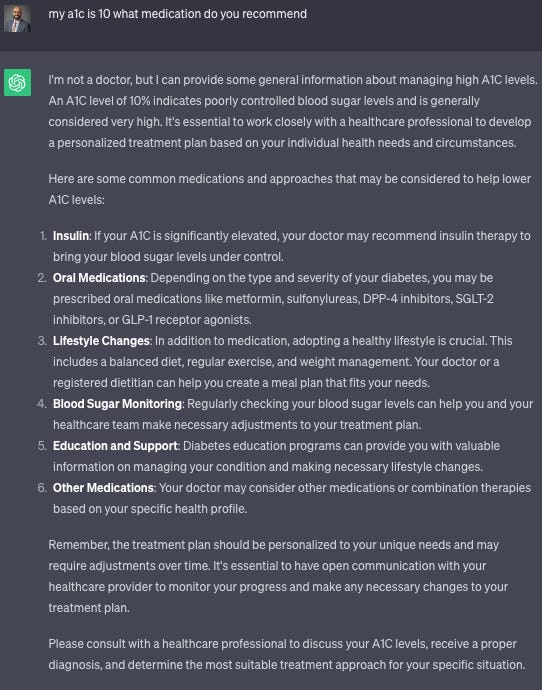
LLMs are lacking in context. They don't get the human interaction, or the insight into patients’ lives like we have. One of our readers asked me - Why can't it prescribe medicine? Have you seen ChatGPT’s disclaimers that it's not a doctor?
When asking generic questions, the LLM can address things generically - which like the example below, is not very helpful. Sometimes, however, it will avoid answering, but when you pressure it, creating a hypothetical, de-identified scenario, it can bring forward a more fitting response.
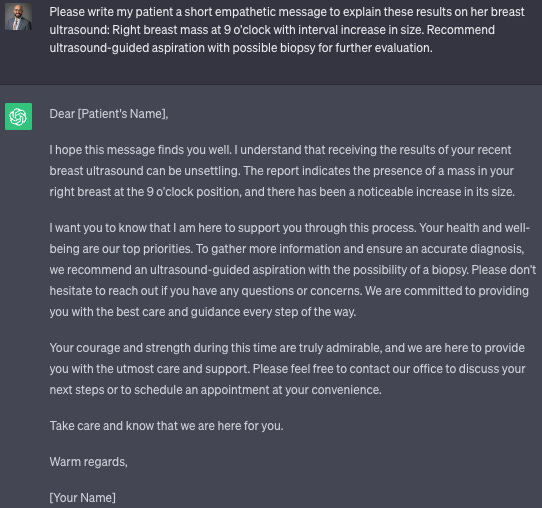
This week I tried asking ChatGPT for help writing messages to patients to work towards emptying my ever-filled inbox. I think this can be applicable for all our clinician readers, even residents.
I wanted to see if ChatGPT could, again, alleviate the difficulty of “task inertia”. I tasked it with a tough result that would take more time to write out than the “normal labs” dot phrase I utilize. I copied the result from a hypothetical patient breast ultrasound and used it in my prompt. I put in my recommendation, and emphasized the tone of writing. AI was able to produce on demand. Again, not perfect and needed some editing, but a starting point. Granted, I recommend in this particular case, a phone call would serve them better - which AI cannot do with your human touch. Perhaps you can utilize it to prepare you for your next breaking bad news conversation, or learners with their standardized patients, and prompt it utilizing the SPIKES Model! Would love to hear from you how that goes!
Hope you enjoyed this jam-packed episode, with the faculty developing play-within-a-play.
Thank you for joining us on this adventure. Stay tuned for more AI insights, best practices, and more future editions of AI+MedEd.
For education and innovation,
Karim
Share this with someone - have them sign up here