
Episode 48
Vibe Coding for GME

Educators in Medicine,
In this newsletter, we continue our journey through the fundamentals of AI, its applications in medicine, and its transformative role in faculty development and education. Let’s dive into learning.
Since we last connected, I’ve been tinkering with a new prototype — something that might (I believe) help residency programs not only keep an eye on board prep, but actually intervene before it is too late.
1. Why Board Review Matters (and Why Everyone’s Talking About Pass Rates)
Whether it’s Family Medicine, Internal Medicine, Pediatrics, Gen Surg, or any other specialty, board exam pass rates are a big deal — for the individual resident’s career, for program reputation, and for institutional accreditation. A dip in pass rates triggers faculty meetings, remediation plans, and occasionally a “we need to overhaul our curriculum” scramble.
Board review is the daily grind that underpins success here — and question–answer practice is still king. In fact, in Family Medicine, your In-Training Exam (ITE) score isn’t just a grade — it’s tied via a Bayesian predictor of your eventual board performance. Strong ITE numbers mean a smoother glide path to board certification. Low scores? That’s a flashing early-warning light that engages the faculty contingency plan towards saving the at-risk learner.
Which is why I believe tracking performance in real time — not just once a year — can make all the difference.
2. Introducing the v0 Family Medicine Board Review Tracker
I’ve been “vibe coding” (read: stitching together a functioning prototype without obsessing over every edge case) to see if a lightweight, scalable platform could help programs stay on top of resident board prep.
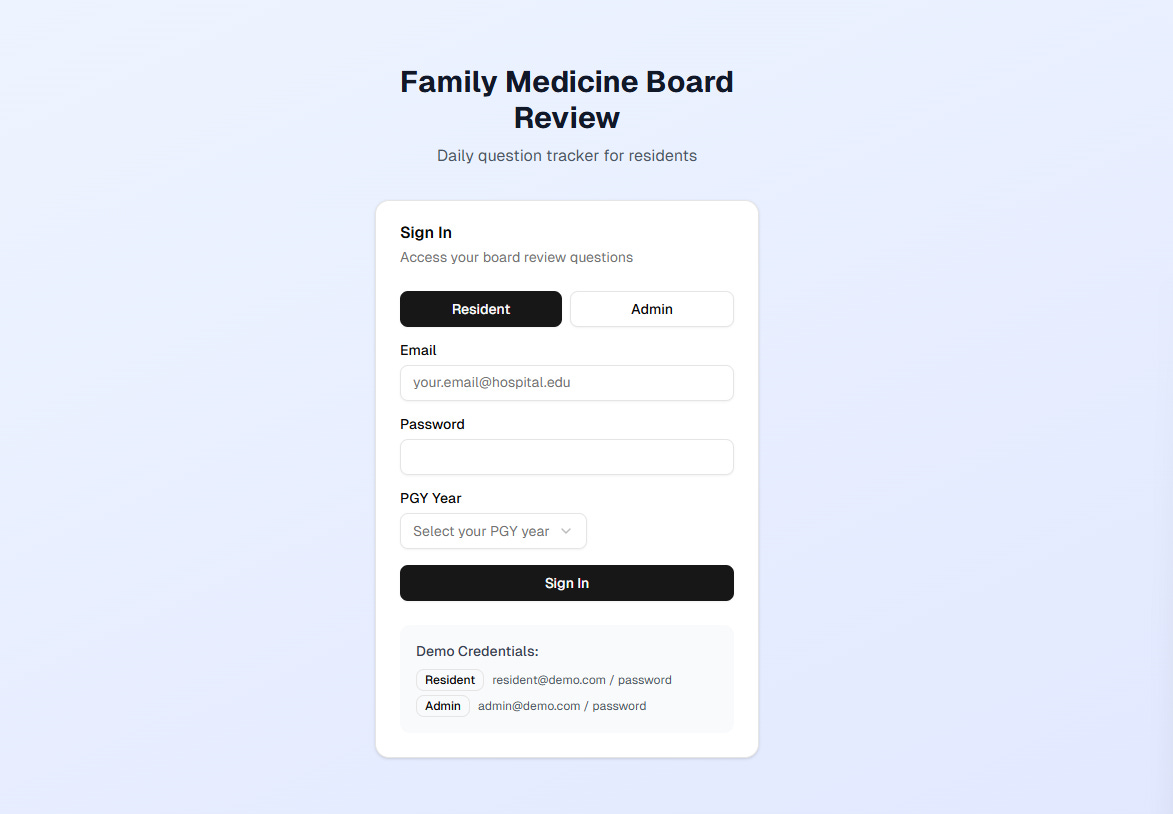
I built it with prompting. I taught it by saying the following:
As a Family Medicine residency program director, I want to create a Board Review Question Tracker designed to help residents prepare for the In-Training Exam (ITE) and board certification through consistent, data-driven practice. The tool should automatically delivers three to ten board-style questions each day, with the exact number configurable by the program administrator. Questions and explanations are sourced from uploaded PDFs, which are parsed into a searchable question bank. Residents should receive immediate explanations after each question, reinforcing correct answers and clarifying mistakes.
Each resident logs in through a portal that includes their PGY year, allowing for tailored class-year comparisons. To keep motivation high, the system incorporates gamified features such as streak tracking, a scoring system that rewards both correctness and speed, and leaderboards for peer-to-peer competition. Residents can monitor their own performance trends over time, building both confidence and accountability.
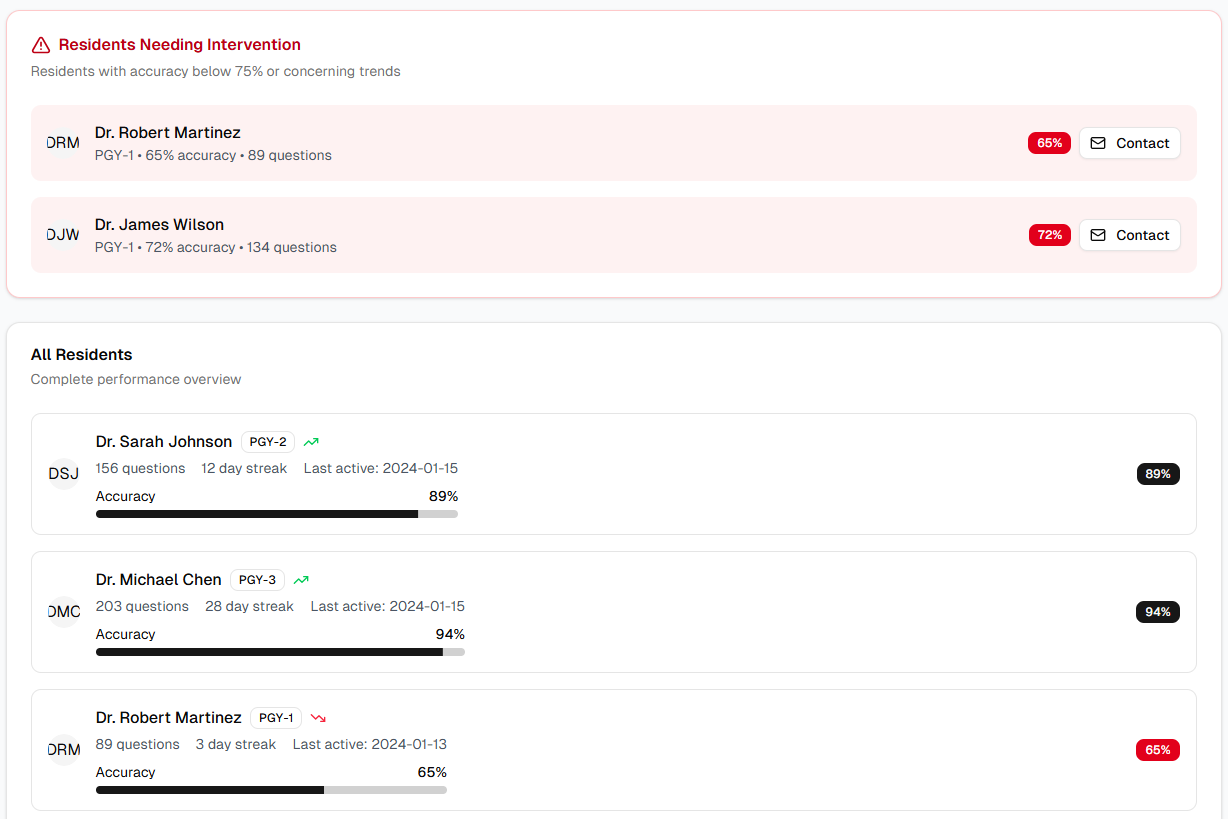
On the administrative side, a separate dashboard provides full analytics, including percent correct, daily completion rates, and performance trends over time. The system can flag low-performing residents early, enabling targeted intervention before ITE or board scores are at risk. Administrators also have full control to edit settings, upload new PDFs, and adjust the number of daily questions. While the default configuration assumes eight residents per year, this number is adjustable so other programs can adopt the system. The goal is to make board preparation consistent, measurable, and motivating — turning daily questions into a predictive and proactive tool for resident success.
If you want to check it out more, here’s the demo link:
👉 v0-family-medicine-tracker.vercel.app
Demo Credentials:
Resident: resident@demo.com / password
Admin: admin@demo.com / password
First List of Core Features (Current Prototype)
Authentication/log-in system with separate resident and admin logins, plus PGY year selection.
Resident dashboard — daily question delivery, performance tracking, streaks, and gamification.
Admin dashboard — analytics, question management, program settings.
Question session interface — explanations + scoring.
Leaderboard system — track class rankings and performance comparisons.
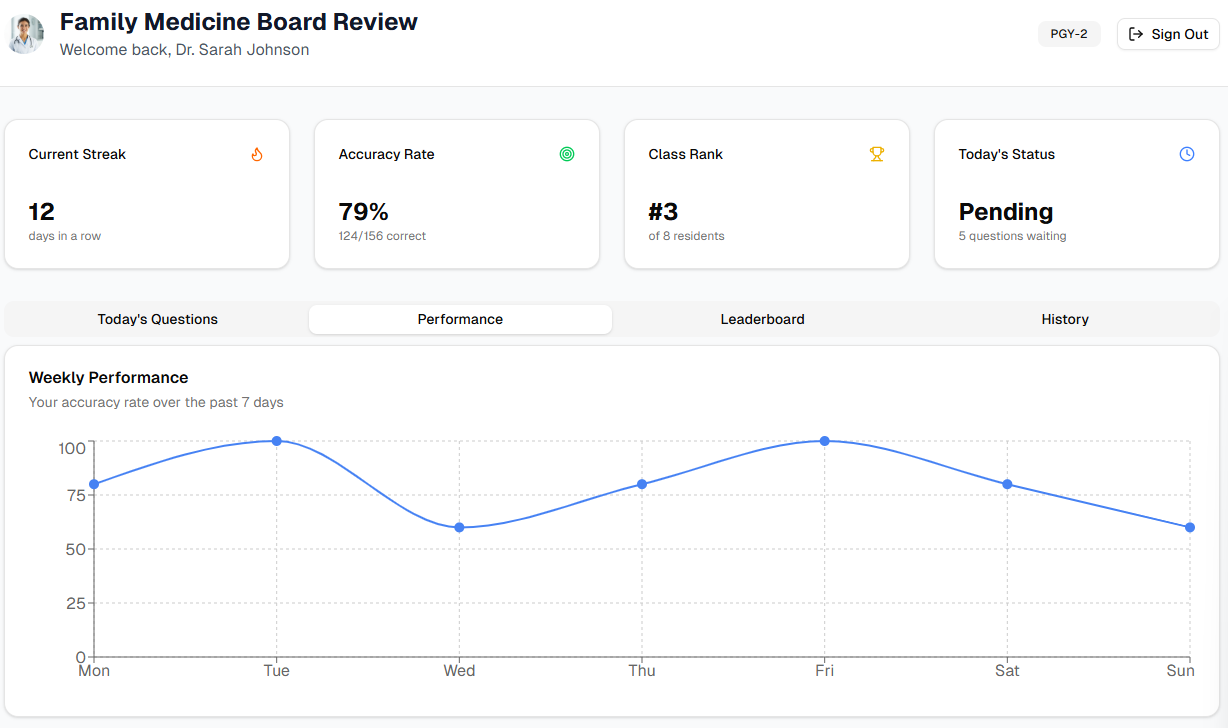
Key Components:
Daily question delivery (3–10 per day, configurable).
PDF upload for extracting questions & explanations.
Gamification with streaks, time bonuses, and scoring.
Scalable to handle different resident counts per PGY year.
⚠️ Important: This is a demo — dummy data, surface-layer functionality. It’s here to spark ideas, not to be used for actual program tracking (yet).
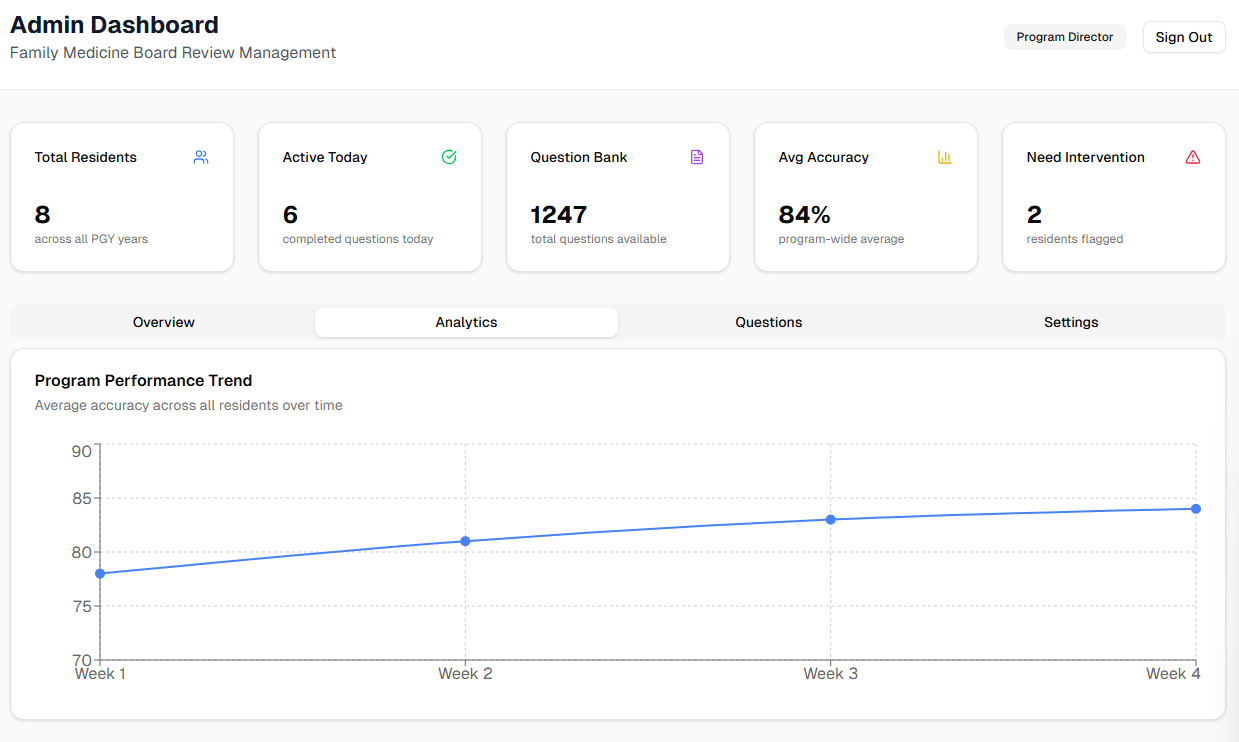
In my opinion, students and residents pay for 3rd party question bank services for the content, but even more so for the data. Performance analytics with intervention alerts for low performers would bring so much value to a tool like this, and probably is my favorite feature — flags struggling residents early so we can act before it’s too late. It also gives me a bird’s eye view, are the residents getting the board review done?
3. Why Vibe Code at All?
Vibe coding is basically building something quickly enough to test a concept without committing months of development time. But doing so for non-coders hadn’t been so easy before LLMs and chat-interfaces. This allows for rapid iteration — going from idea to clickable demo in minutes.
These versions are certainly minimalistic, prone to issues, lack polish and are not ready for production use.
This one Ibuilt using v0.app, which had a free trial at the time I wrote this post. There are plenty of similar tools (Google, Replit, Glitch, Codesandbox, etc.) — pick one, spin something up, and see what sticks.
4. What’s Next?
Here’s where I’d love your input:
What would you want in a full version of this tool?
Is the low-performer alert worth investing in for your program?
Should we expand question sources, ITE integration, or adaptive learning?
Is this grant-worthy to build out a robust, scalable version?
Interested in partnering?
Email me or comment — I’m genuinely curious!
💌 As always, thanks for reading. Get in touch and let me know your thoughts!
Thank you for joining us on this adventure. Stay tuned for more AI insights, best practices, and more future editions of AI+MedEd.
For education and innovation,
Karim
Share this with someone - have them sign up here.