
Episode 67
The Third Thing(?) in the Ring

Educators in Medicine,
In this newsletter, we continue our journey through the fundamentals of AI, its applications in medicine, and its transformative role in faculty development and education. Let’s dive into learning.
I had an email exchange last week with Dr. Xavier Prida, our cardiology fellowship program director and a good friend. It was bringing about whether AI in the exam room is closer to a consultant we curbside, or a third party we have to babysit.
He said some things I have not stopped thinking about. So I wanted to share from the conversation two new pieces of literature. One asks whether the AI can carry the warmth of an encounter. The other asks who gets blamed when the encounter goes wrong.
🤖 1: When the Chatbot Sounds Warmer Than We Do
A new POEM landed in my inbox with a title that, even by POEM standards, is a little provocative: “Chatbots may be able to substitute for humans when responding to medical questions.” (Wiley, Essential Evidence Plus, summarizing Ruben MA, Blanch-Hartigan D, Hall JA. J Gen Intern Med 2025 Dec 8, online ahead of print.)
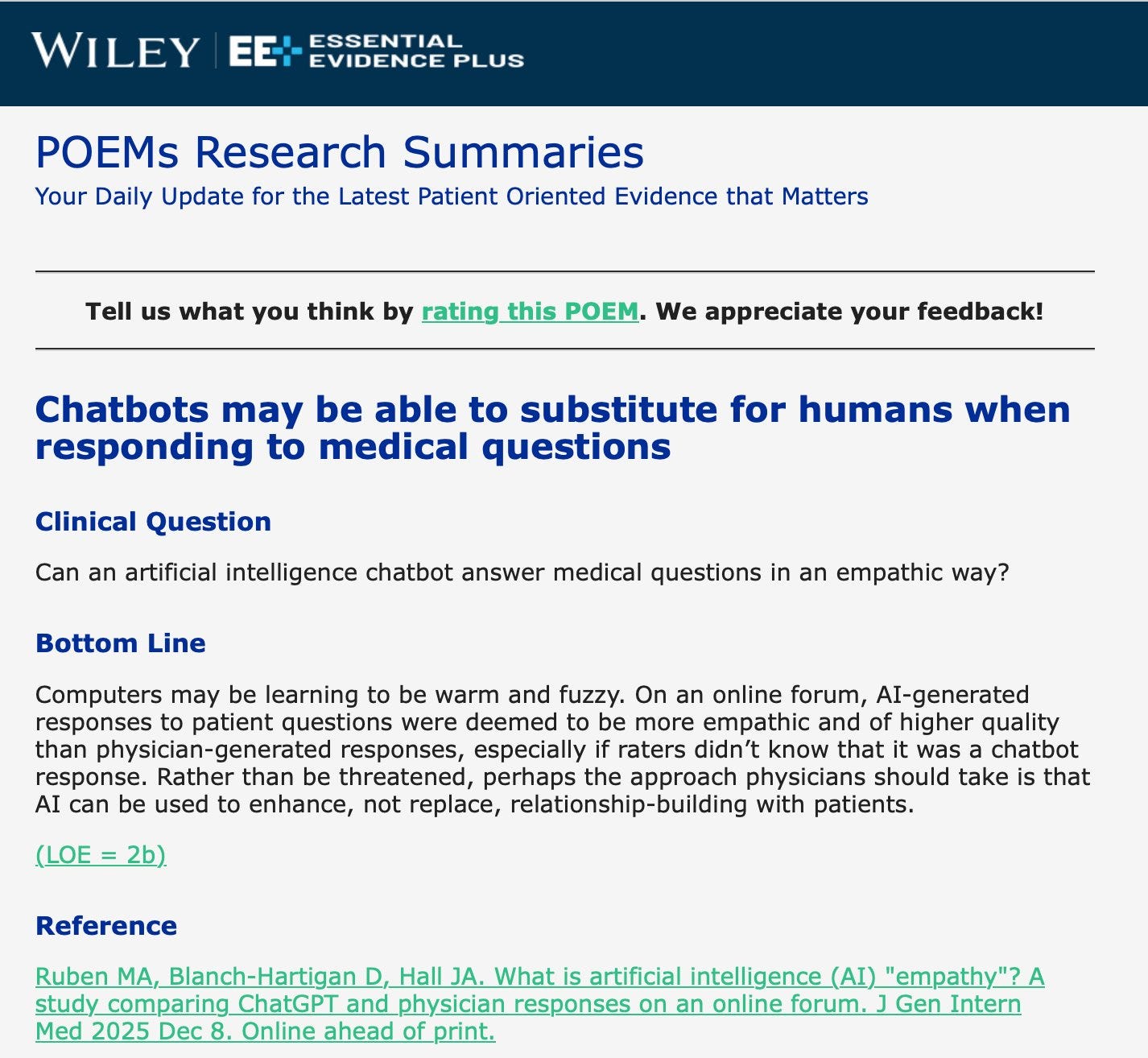
The setup: 65 real patient questions pulled from Reddit’s r/AskDocs, each answered both by a physician and by ChatGPT. Then 1,454 online raters scored both responses for empathy, quality, trust, liking, and goodness.
The bottom line, in the authors’ own words: “Computers may be learning to be warm and fuzzy.”
A few details worth chewing on:
The chatbot was rated more empathic than the physicians, with P < .001, whether or not the raters were told who wrote the response. Quality, trust, liking, and goodness all followed the same pattern.
When raters were told a response was physician-authored (even when it was actually AI), they rated it as more empathic. So we still get a halo just for being human. We just don’t always earn it on the page.
In the formal coding, chatbot responses contained more validation, reassurance, and nonjudgmental language. They were less rushed and more structured than physician responses.
Two important caveats from the synopsis (Allen Shaughnessy, PharmD, MMedEd, Tufts) that should shape how we read this. The physicians were not responding to their own patients (no relationship, no chart, no chair pulled up to the bedside). And the chatbot has effectively unlimited time at no marginal cost. We have eight minutes and a full waiting room.
So what do I take from it, as an educator?
The structural advantages of the chatbot, time, validation language, calm sentence rhythm, are coachable. Those are things I want to start teaching residents to do explicitly. We can use the chatbot as a mirror, not a competitor. This is not a threat. It is a free coaching resource. I don’t care to admit it, but even texts to my closest family can seem “short” at times because of us being busy. I am not terribly surpised at this - but hope it makes us do better, not worse.
(LOE = 2b, for those keeping score at home.)
🥊 2: Relearning Our Clinical Encounters, with a Third Person(definitely not a person) in the Ring
This brings us to the more uncomfortable piece, an analysis in The BMJ (Mateen and colleagues, BMJ 2025;393:bmj.s874) on what role AI is actually playing in the consultation room. The figure (below) lays out two very different models of AI in clinical care.
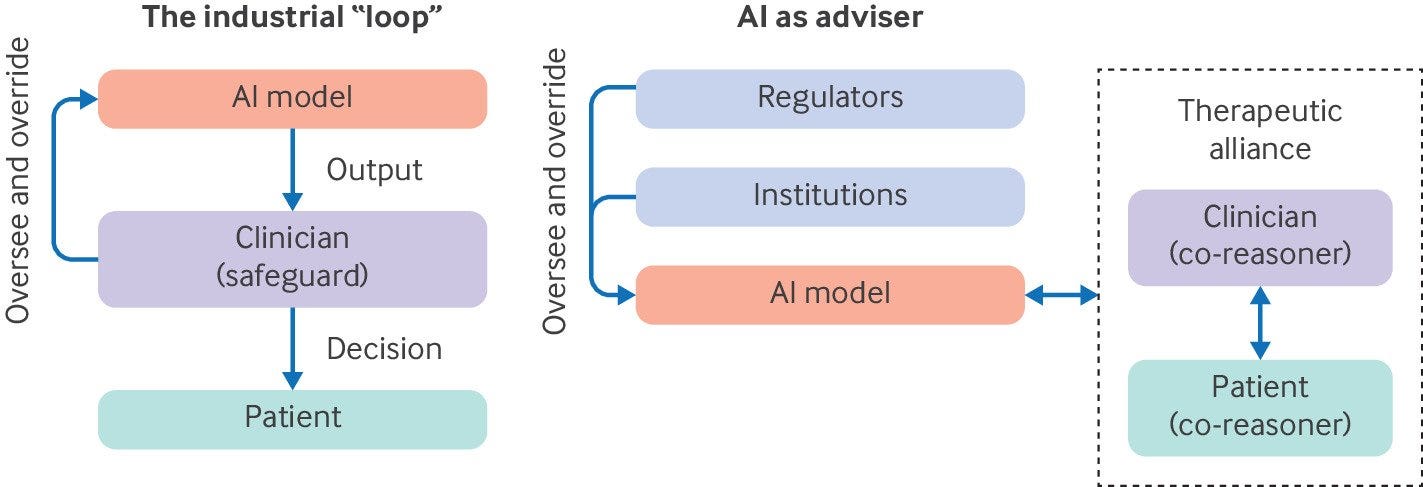
On the left, the “industrial loop.” The AI model produces an output. The clinician sits between AI and patient as a “safeguard,” meant to oversee and override. The clinician then carries the decision down to the patient.
On the right, “AI as adviser.” The AI model is one of several advisers, alongside regulators and institutions. The actual relationship, the therapeutic alliance, is between the clinician and the patient as co-reasoners. The AI advises that alliance from the side.
Two different jobs.
Here is where Xavier’s boxing metaphor unfolds. In boxing there is a phrase, “the third man in the ring.” He is the referee. He is in the ring with the two fighters. He cannot win the fight for either of them, and he cannot throw a punch, but he absolutely can stop the fight. He is present, he is governing, and he is not the contest.
In the industrial loop, the clinician is the third man in the ring. We are in there with the AI and the patient, and our job is to override the AI when it is wrong. That sounds noble. It is actually a setup. The BMJ piece calls this the “moral crumple zone,” a term borrowed from autonomous vehicle research. When something goes wrong, the human in the loop absorbs the impact, legally and morally, even when the actual structural decision was made upstream by the model, the vendor, or the institution that deployed it. The crumple zone protects the rest of the car. It does not protect itself.
In the “AI as adviser” model, the third man in the ring is the AI. It is present, it can flag a foul, it can offer a read of the action, but the fight (the actual reasoning, the actual decision, the actual relationship) is between clinician and patient. Regulators and institutions take over the oversight role that was quietly outsourced onto the individual clinician. The clinician stops being a one-person liability.
Why does this matter for medical education? Because the two models train two different physicians.
If you’re an NBA fan - same thing on the court, especially in the playoffs. Last week, this example was of a ref maybe getting too involved. If this was AI - perhaps we wouldn’t be so excited for our learners? or our patients?
The industrial-loop physician learns to be defensive. Every AI output is something to check, override, and document around. The skill being practiced is suspicion. Over time, the muscle that atrophies is independent clinical reasoning, because reasoning has been redefined as adjudicating the AI’s output instead of building your own.
The co-reasoner physician learns to be in dialogue. The skill being practiced is integration: articulating to the patient what the AI suggested, what you think, where you agree, where you don’t, and why. That last bit (”and why”) is the entire ballgame. It is also exactly the kind of bedside articulation we have always wanted residents to develop.
So the question Xavier asked me, “Can we learn as we go?”
I think we can, but only if we are honest about which model our current curriculum is accidentally training.
Teach the override as a reasoning act, not a reflex. When a resident disagrees with an AI suggestion, the evaluable skill is the articulation, not the click. Make them say, out loud and on the record, why.
Name the crumple zone for what it is. Residents need to know that “the AI said so” or “I overrode the AI” both miss the point. The point is the reasoning that sits underneath either action.
Practice the co-reasoner sentence. Something like: “This model is suggesting X. Here is what I am weighing against that. Here is what I would like us to decide together.” That sentence, said out loud in front of a resident/patient, is the point of the BMJ paper.
Boxing is not actually about the referee. It is about the two people in the ring, and whether the contest is fair. AI in medicine is the same. The model is not the story, and really should not be noticed (in my opinion). The clinician and the patient, deciding together, are the story. Our job, as educators, is to keep building physicians who know they are in the ring, not standing outside it watching a machine swing.
💌 As always, thanks for reading. Get in touch and let me know your thoughts!
Thank you for joining us on this adventure. Stay tuned for more AI insights, best practices, and more future editions of AI+MedEd.
For education and innovation,
Karim
Share this with someone, have them sign up here.