
Episode 70
Happy New (Academic) Year.

Things have been a blur lately. We just wrapped up orientation for our incoming class of residents, and watching their nervous energy and raw idealism always brings me back to my own first days. There is a sacred, heavy responsibility in taking these bright minds and guiding them through the transition from students to practicing physicians. SO, sorry I haven’t kept up with this work as often as I’d like!
As I worked through the welcome lectures and tech/ehr onboarding, I couldn’t stop thinking about a recent Talks at Google interview featuring Dr. Robert Wachter, author of A Giant Leap: How AI Is Transforming Healthcare. I shared it with my residents, encouraging them to be “system thinkers” and offered them coffee for their reflections (no takers yet).
His insights on medical education hit incredibly close to home, forcing me to look at our new trainees through an entirely different lens. Watching Dr. Wachter speak about how AI interacts with medical education felt like holding up a mirror to the exact curricular tensions we are wrestling with right now. He pointed out a fascinating paradox: while enterprise AI deployment is usually driven by standard return-on-investment metrics or system efficiency, academic medical centers have a secondary, much more complicated governance problem. We have to figure out how to deploy these tools without accidentally “deskilling” our learners.
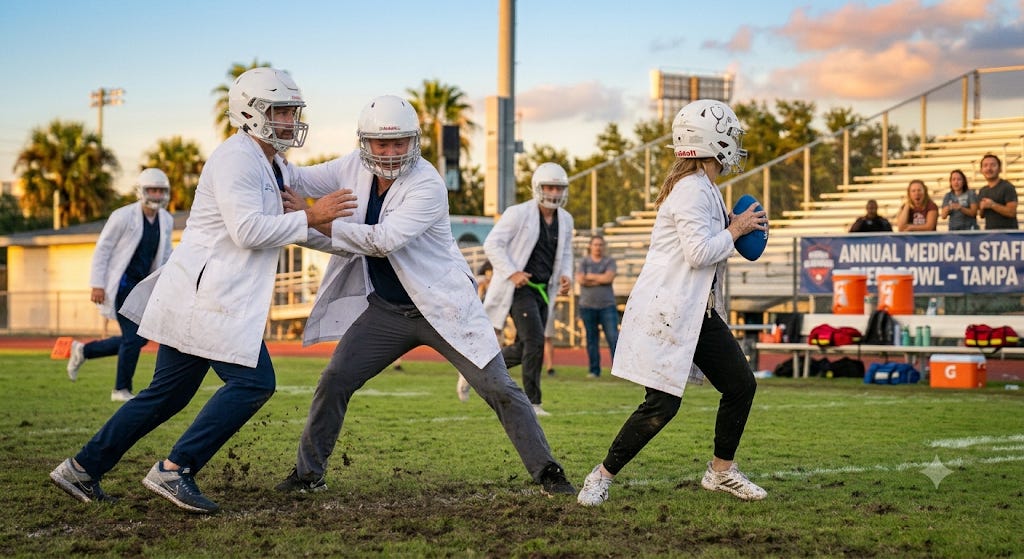
Wachter noted emerging data suggesting that when novices are exposed to highly capable, predictive tools too early, it can actually stunt their cognitive development. We’ve discussed this many times, and I KNOW we’ve discussed these things across the country. If a tool writes the note or summarizes the chart perfectly from day one, how does a resident learn the fundamental “blocking and tackling” of clinical reasoning? Blocking and tackling is a popular phrase originating from American football (for the unaware) that refers to mastering the basic, foundational skills required to succeed. While it describes the physical core of football, it is widely used as a metaphor in corporate, leadership, and operational strategies. We aren’t quite ready to take the cognitive heavy lifting off the plate, even if we are finally ready to retire the Krebs cycle from the mandatory memory banks. You can’t score if the blocking isn’t happening.
The concept that resonated with me most deeply was his breakdown of the “human-in-the-loop” dynamic and why expert use of AI is fundamentally different from novice use. Wachter shared a striking study from Oxford where patients and an AI model interacted. When the AI was given a textbook prompt of the “worst headache of your life” (the classic clinical indicator for a life-threatening subarachnoid hemorrhage), it correctly told the user to go straight to the ER. But when actual patients interacted with the bot, they phrased it as “a really bad headache,” causing the tool to mistakenly recommend rest and Tylenol. For those in medicine, the phraseology seems so obvious, but the context is missed, like in idiom translation. “Take it with a grain of salt” may not make sense in Arabic or Spanish like it does in English.

As an educator, this was a massive lightbulb moment for me. Experts instinctively know which 5 out of 200 disparate data points are the salient ones to feed into a prompt, and they possess the clinical judgment to look at an AI’s output and say, “No, that’s dangerous and stupid.” Novices simply don’t have that interpretive layer yet. If we don’t intentionally train our residents to understand when these tools are trustworthy, how to spot subtle automation bias, and how to remain eternally vigilant when a system has been right 39 times in a row, we are failing them. We have to teach them to be the final, human arbiter in high-stakes environments.
Ultimately, the interview left me feeling challenged. It’s easy to write newsletters, give presentations, and philosophize about how AI will democratize and improve our clinical worlds. But the gritty work happens on the ground; building the guardrails, designing the curricula that teach both raw clinical reasoning and advanced tool utilization, and ensuring our trainees don’t lose their analytical edge.
It also left me feeling a bit bothered that we’re bogged down as clinicians, unable to innovate at times. This year, I aim to spend less time talking about healthcare technology and more time doing the things to build it. The status quo of medical education won’t evolve on its own, and our new class of residents deserves a curriculum that prepares them for the reality of the world they are inheriting.
💌 As always, thanks for reading. Get in touch and let me know your thoughts!
Thank you for joining us on this adventure. Stay tuned for more AI insights, best practices, and more future editions of AI+MedEd.
For education and innovation,
Karim
Share this with someone - have them sign up here.
Thank you for sharing the video. Although I wasn't shocked by any of their comments it supported the notitions I have building and using the agents and chatbots I design for other pediatricians.
The Oxford example you cite points at something sharper than a translation problem. The tool did not simply miss the patient’s phrasing. It worked precisely on the phrasing an expert would use.
“Worst headache of your life” already contains the clinical compression of risk. The danger has been sorted into the words medicine uses for it. “A really bad headache” is how the person carrying that danger may actually bring it in. If the system performs only after the experience has been translated into clinical vocabulary, it presumes at the door part of the expertise it promises to supply.
That reframes the deskilling worry from the other side. The tool is weakest where its promise was largest: with the untrained user it was supposed to help. Its implicit user turns out to be someone who already knows what matters and how to say it.