

Educators in Medicine,
In this newsletter, we continue our journey through the fundamentals of AI, its applications in medicine, and its transformative role in faculty development and education. Let’s dive into learning.
After being on a year-long hiatus, I’ve finally reactivated my Linked In account . If you’re on there, lets connect! In all honesty, I am not a big fan of social media, but I believe its a place where friends can support one another. I am finally sharing openly about my startup ResiLearn, ready to scale it across the world. IT IS FREE BOARD PREP TO ALL WHO SIGN UP! We want as many medical students, residents, and attendings using this platform as possible. Gamified board review (think DuoLingo) with spaced recall (think Anki), and data, data, data.
Are you interested? We’d love to get this tool into your hands for free — just reach out at support@resilearn.com and we can help you get your friends group, residency program, department faculty, or even med school onboarded! We’ve got over 800 users on board with over 200,000 questions answered. Did I mention there are prizes?! More to come on ResiLearn in the future episodes.

If you would be so kind to share about it with all those in your circle? That would be so helpful to me! Let’s make learning fun!
🩺 1: Three Names You Already Know
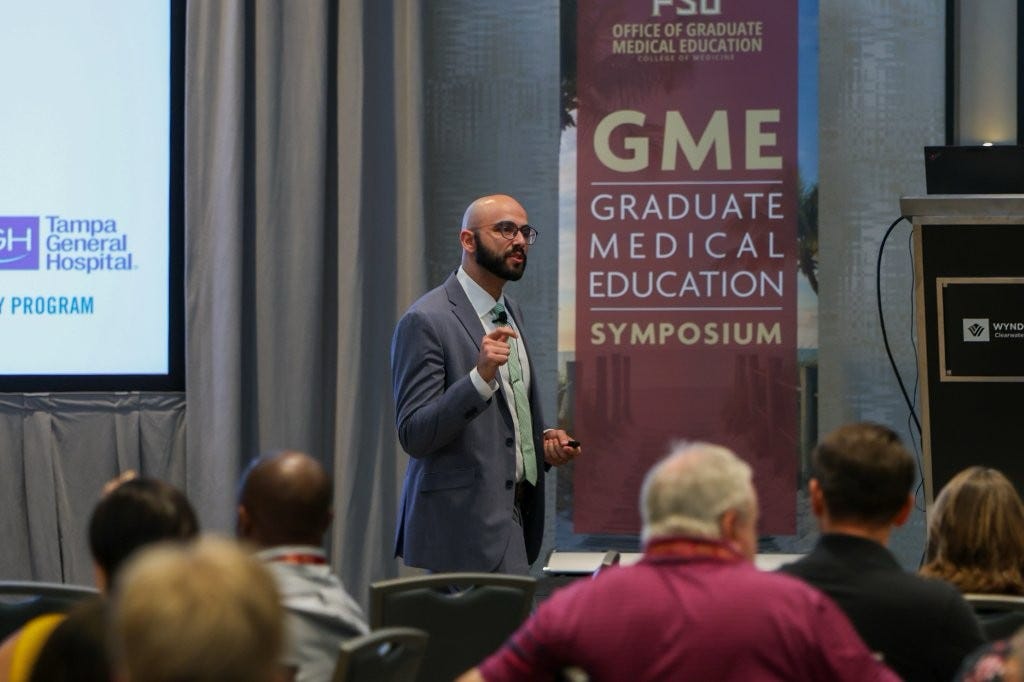
I was invited to talk last week at the FSU GME conference for faculty and staff at their state-wide meeting. What an honor! It was fun till someone asked me which OpenEvidence “model” to use. I did not have a great answer. I had been clicking whatever was default. So I went and read the user guide. OpenEvidence now offers a family of models, and I like what they did with the names: Osler, Sackett, and Snow. Every model is held to the same standard of accuracy. What changes, in their words, is time: how long the model thinks and how deep it searches. All three are free and unlimited to verified clinicians.
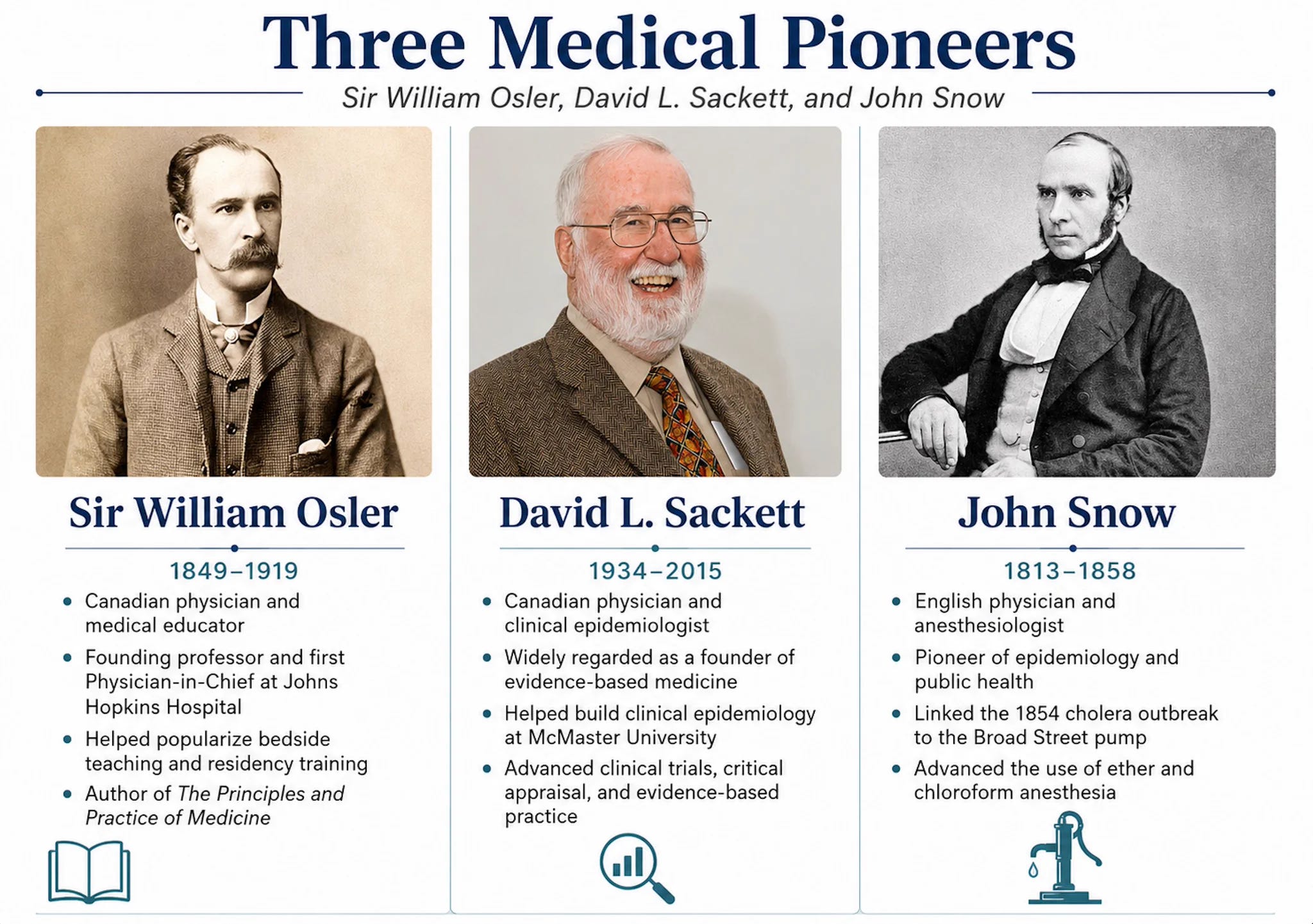
Osler is the default. Direct answers in seconds, citation-backed. A dose, a diagnostic criterion, first-line therapy. It is the OpenEvidence most of us already know, and it is named for the man who brought teaching to the bedside.
Sackett takes seconds to a minute. It surveys more of the evidence, writes longer, and is more likely to ask you a clarifying question when a clinically significant detail is missing. Named for David Sackett, who insisted that a good answer starts with a well-framed question.
Snow takes five minutes or more. It runs a full investigation and returns a structured report. It is the successor to Deep Consult, built for complex differentials, treatment under competing comorbidities, and questions where the literature itself is unsettled. Named for John Snow, the anesthesiologist who traced cholera to a single pump by patient, systematic work.
There is also Darwin, a research preview available by application only to institutional partners and researchers benchmarking safety and accuracy.
As an educator, the model selector is a clinical reasoning question in disguise. This decision is the judgment I want residents to develop about consults, about imaging, about whether to admit. Is it a curbside? A formal consultation? A hope that rheumatology comes up with something from the scraps?
⏳ 2: The Hours We Get Back Are Not Free
Patel, Dee, Toby, Ramos, and Celi, writing in Medical Teacher: “The physician as a catalyst: Reimagining medical education for an AI era.” Leo Celi’s name on a medical education paper is enough to get me to open it. I met with him years ago when I first learned about clinical informatics.
This paper argues that AI’s absorption of diagnostic cognitive tasks creates a time-limited opening in the curriculum, and that if we do not deliberately claim that time, productivity pressure will take it.
They lay it out in phases. Near term, algorithmic literacy modules and protected time for advocacy. Medium term, as AI carries more of the diagnostic load, deliberate training in the structural differential, the social and systemic drivers behind the presenting complaint. Long term, physicians retrained primarily as systems navigators and advocates for patients.
You can argue with the long-term vision. I do, a little. I am not ready to hand off diagnosis as a competency, and Episode 70 was an entire post about why novices who skip the blocking and tackling do not become experts. But the central claim is warning that nobody is going to protect the hours for you.
Let’s stay thoughtful about impact and the direction we’re heading.
💌 As always, thanks for reading. Get in touch and let me know your thoughts!
Thank you for joining us on this adventure. Stay tuned for more AI insights, best practices, and more future editions of AI+MedEd.
For education and innovation,
Karim
Share this with someone - have them sign up here.