

Educators in Medicine,
In this newsletter, we continue our journey through the fundamentals of AI, its applications in medicine, and its transformative role in faculty development and education. Let’s dive into learning.
🏆 Before We Begin: ResiBowl Has Its First Champions
Congratulations to the Halifax Health Family Medicine Residency, winners of the very first ResiBowl! Their residents took on the field in board review questions on ResiLearn, came out on top, and won themselves a party. Judging by the confetti, they collected (thanks to some AI-powered faculty editing!).
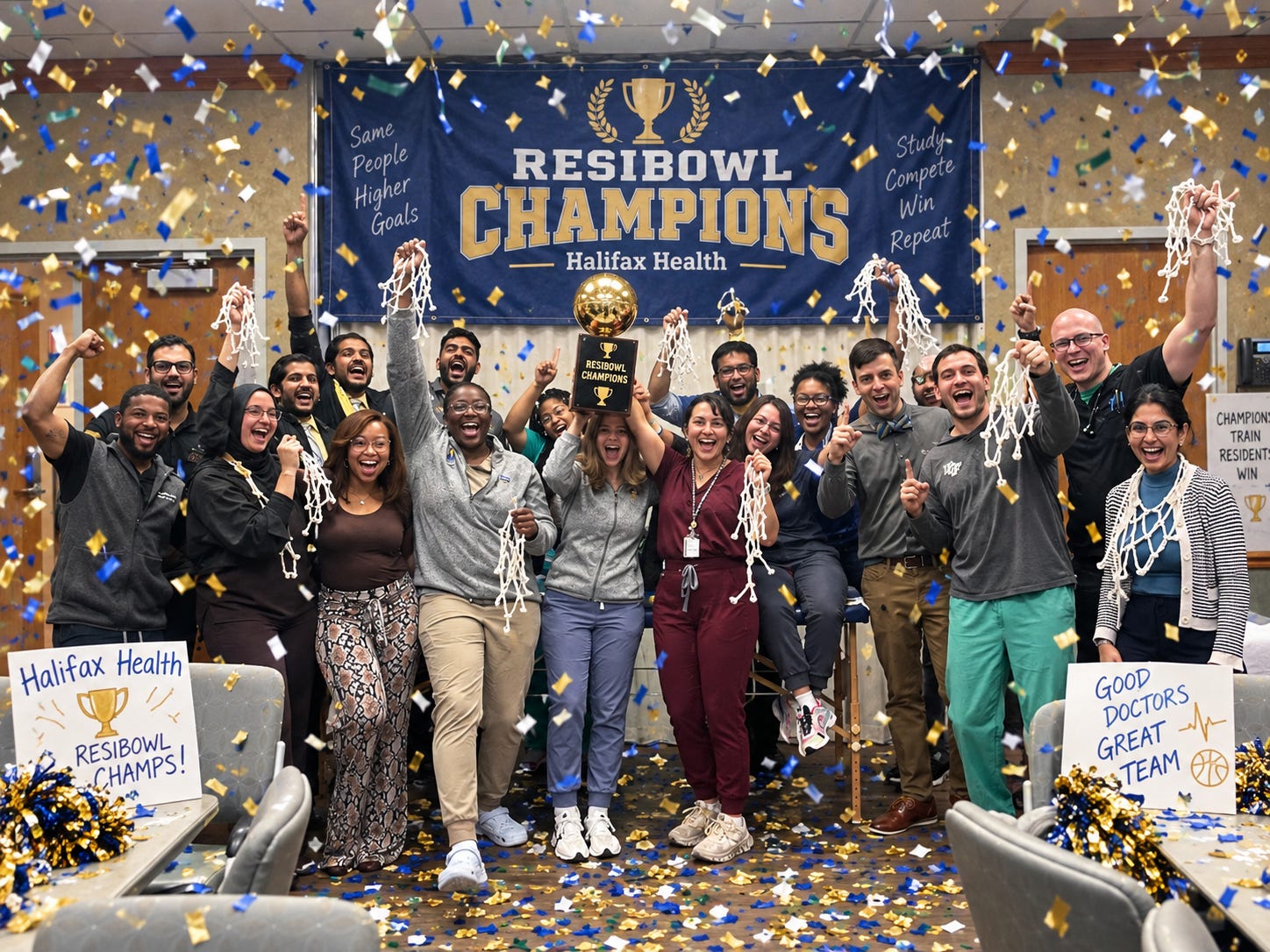
They cut down the nets and everything. I built ResiLearn because board review doesn’t have to feel like a chore. When learning becomes a team sport, residents show up, and they bring their friends.
We want to announce that ResiLearn is no longer just for family medicine. FREE board review is now live for:
Family Medicine
Internal Medicine
Pediatrics
Emergency Medicine
OB/GYN
General Surgery
USMLE + COMLEX 1, 2, and 3
If your medical school or residency program wants in on the next ResiBowl, come find us at resilearn.com.
Now, on to this week’s letter.
Dear Epic,
We need to talk about SlicerDicer🔪 . Every time I use it, my eyes water.
I had given up on SlicerDicer till Epic came to our institution and held a hackathon. It was encouraged and I thought, let’s give it another chance.
Here is what I want: How many patients did I see in the last 6 months, that have diabetes and have an A1c over 9? That’s it. Simple enough? I want it for our trainees…Look at what the ACGME asks of us:
Residents must receive regular data reports of individual/panel and practice patterns, as well as the training needed to analyze these reports.
Reports should include clinical quality, health disparities, patient safety, patient satisfaction, continuity with patient panel and referral, diagnostic utilization rates, and financial performance.
Each FMP site must participate in ongoing performance improvement, and demonstrate use of outcome data by assessing the following: clinical quality for preventive care and chronic disease; demographics; health disparities; patient satisfaction; patient safety; continuity with a patient panel; referral and diagnostic utilization rates; and financial performance.
Each FMP should measure and report this data to the FMP care teams and appropriate preceptors at least semi-annually.
…and those are the vague/simplistic words. The ACGME wants empanlement, encounters, and continuity numbers for our residents.
But I’m going to keep it real - Slicer Dicer is subpar. Its slow, clunky, and doesn’t actually give me the people I need to work on the outreach for uncontrolled DM. After clicking boxes, I get a result of 4 patients, which is wrong, because I have more than 4 patients with uncontrolled diabetes and I know most of them by name.
So I try Reporting Workbench. Reporting Workbench is where good intentions go to wait in a queue. I find a template someone built years ago called “DM Registry FINAL v3 (USE THIS ONE).” I run it. It is still running.
Then I remember: we have AI now! The little sidekick in the sidebar. This is going to be magical. I type my question in plain English, the way I was promised. It tells me my prompt is too long. I shorten it. I shorten it again. By the time it fits, I’m basically writing a pager message: “A1c >9 my pts?”
The sidekick thinks about it, then politely tells me it can’t help with that.
Epic, you have built a system that knows everything about my patients and will tell me almost none of it. I know you can do better. I shouldn’t need an entire IT Team of Epic certified builders to query my patient panel. It’s a base expectation now for our learners.
I’m a program director. I’m supposed model these behaviors, and to show that my residents are seeing enough patients, the right patients, and getting better at caring for them. I want to tell a resident, “Your blood pressure control rate went from 58 to 71 percent this year. Look at you.” That sentence should take a few clicks. Today it takes a request ticket, an analyst, a three-week wait, and a spreadsheet that arrives after the teachable moment has left.
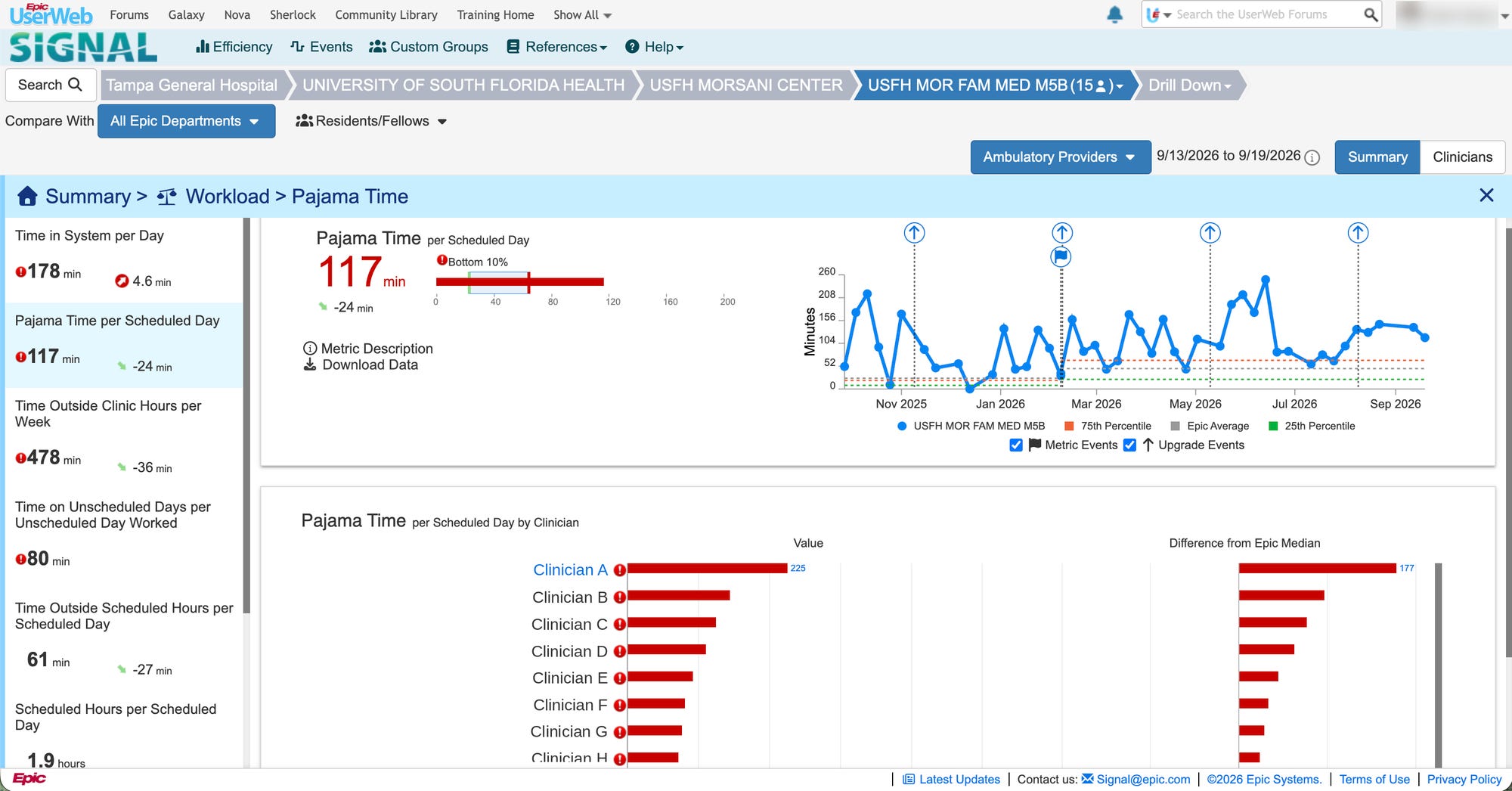
I am here to say the EHR should be a teaching partner. My residents spend more time with it than they spend with their faculty. I just pulled a '“pajama time” report - its heart breaking to see. We’re not setting them up for success. If it can remind them to document a BMI, it can show them their own panel. Data learners can see is data learners can learn from. Data locked in a report queue is just useless.
(deidentified…)
A short wish list:
Let me ask a question in plain language and get a number. Show me the query behind it so I can check the work.
Give the sidekick a prompt box bigger than a tweet. Clinical questions have context.
Give every resident a personal panel dashboard, built in, customizable, meeting going beyond the ACGME expectations. There are over 800 residency programs in FM alone, I know we’re not the only ones.
🩺 Part 2: Congratulations, and... When?
Now, credit where it’s due. A friend shared with me that Greg Samios, CEO of Wolters Kluwer Health, shared that UpToDate will be available within Epic’s Evidence in Art and Agent Factory, with trusted, traceable clinical content embedded right in the workflow.
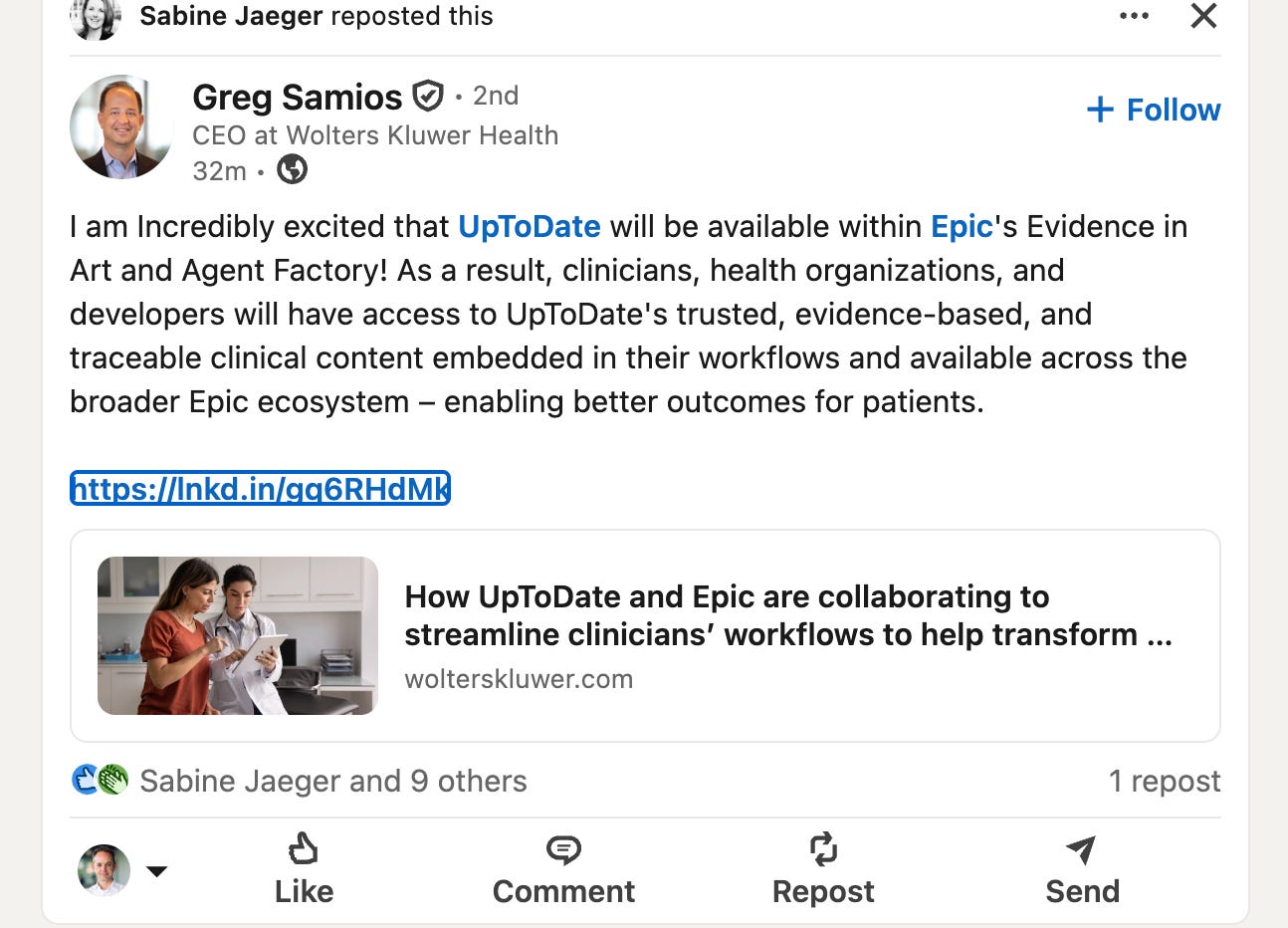
Look at that photo. A clinician and a patient leaning over a tablet together, smiling at evidence. Nobody clicking out of the chart, or logging into a second window with a password that needs resetting. Nobody is Googling “USPSTF lung ca screen” on a phone under the desk. The patient is smiling at an EHR, which is how we know it’s staged.
But that picture is the goal, and I mean it. Bravo.
I just have one question: What are we waiting for?
Epic, you tell us Cosmos holds something like 320 million patient records. You can show me how patients like mine, across the whole country, did on one treatment versus another. You can compare my patient to a patient in Wisconsin faster than I can type this sentence.
And yet when I sign an order for a DEXA, a statin, or a head CT, nothing next to that order tells me what the evidence says. The evidence exists. UpToDate has it. You have the pipes.
What I’d love to see:
Evidence at the order. When I place the order, show me the one-line recommendation, the grade, and the source.
Let the evidence talk to the data. Tell me what the guideline says and what happened to other patients like mine. Guidelines plus real-world evidence.
Make it teachable. A “why was this suggested?” link.
So, congratulations. Truly. Now please hurry.
With respect, some frustration, and a full In Basket.
💌 As always, thanks for reading. Get in touch and let me know your thoughts!
Thank you for joining us on this adventure. Stay tuned for more AI insights, best practices, and more future editions of AI+MedEd.
For education and innovation,
Karim
Share this with someone, have them sign up here.
Amen! What frustration Slicer Dicer caused us on a simple Hep B vaccine QI project we did in our residency!!
With regard to the question of resident panel management and panel quality metrics: Epic has had a reasonably good solution for this for a long time (c. 2014), and it's called My Panel Metrics. A nice color-coded dashboard, historical trending, benchmarking, and drilldown reporting to validate the data down to the individual patient level. And a segway into bulk communications, bulk ordering, etc. via RWB... so you can actually try to move the needle with some population health initiatives. (MPM reports run fast in RWB!) Some assembly required by the local project team, but not too bad, and it usually can be aligned with the build for the overarching medical group so it's not a separate project. It simply requires organizational commitment to doing some local config to include residents in the deployment.