

Educators in Medicine,
In this newsletter, we continue our journey through the fundamentals of AI, its applications in medicine, and its transformative role in faculty development and education. Let’s dive into learning.
This ResiBowl sprint was a race to answering 50,000 questions, and we met it in less than 3 weeks! We’ve added question banks in Neurology, Psychiatry, PM&R, ENT. Tell others and sign up now!
Now, some good news for anyone who answers clinical questions for a living.
📚 OpenEvidence Just Got a Bigger Bookshelf
On September 29, OpenEvidence announced a new content agreement with Sage:
We are excited to announce that OpenEvidence has signed a strategic content agreement with Sage, bringing peer-reviewed research from more than 300 Sage journals to OpenEvidence. The portfolio spans medicine, nursing, the health sciences, and the life and biomedical sciences.
The agreement includes journals published on behalf of leading medical societies, including the American Orthopaedic Society for Sports Medicine, the World Stroke Organization, the International Headache Society, and the Association of Diabetes Care & Education Specialists. Much of this research is written by specialists for specialists; bringing it into OpenEvidence will help make those findings useful at the point of care, including when clinical questions cross specialty boundaries.
As Sage content becomes available on OpenEvidence, no additional action will be needed. It will automatically inform answers when relevant and will be held to the same standard as every source we use. Each answer will include precise citations and direct links back to the original Sage article.
OpenEvidence remains free for verified U.S. healthcare professionals.
Two things stood out to me.
Specialty journals, generalist questions. “Written by specialists for specialists” is exactly the literature a family doctor rarely has time to read, and exactly the literature we need at the borders. When a question crosses specialty lines, the answer is often sitting in a journal I don’t subscribe to. This is a big reason why I believe these tools broaden our scope and help us provide better medicine.
So many journals. This is the part I just don’t get. OE continues to build these bridges…how are there so many journals?! I have some moral concerns about the practice of ‘peer reviewed publications’ in general, but will spare you the talk this time.
We’re talked before about using these tools with learners. Remember to ask questions: Did you click the link? What kind of study was it? Does it apply to our patient? The tool found the article. Appraising it is still our job, and our learners’ job.
(And yes, in my last post I wrote a letter to Epic asking why evidence takes so long to reach the point of care. The race to bring evidence to clinicians is on, and our patients benefit when it gets easier to find.)
🤖 Personal Agents, the Next Frontier
If 2024 - 2025 were the years of the chatbot, this feels like the year of the personal agent.
What’s the difference? A chatbot answers when you ask. A personal agent works for you between conversations. It can remember your preferences, connect to your email, calendar, and files, run tasks on a schedule, and message you when something is done. Think “assistant who never sleeps.”
Every published a helpful side-by-side comparison of personal agents that lines up eight of them: OpenAI’s Dot, Google’s Gemini Spark, Meta’s Muse, Hermes Agent from Nous Research, OpenClaw, Poke, Grok Bot, and Instinct.
The columns that caught my eye were the control and privacy columns:
What does the agent need your approval for before it acts?
What does it remember, and can you see and edit that memory?
Is your data used to train the model?
How do you delete everything?
I’m trying Hermes. Hermes Agent is open source, meaning the code is public and free to use and modify. You can run it yourself, choose which AI model powers it, set approval modes so it asks before doing anything consequential, schedule recurring tasks, and keep its memory stored locally where you can read and edit it.
My report so far: it’s fun. I haven’t done anything too out of this world yet. But I can text it from my phone and have it act out tasks. So more to come there. I will start with low-stakes tasks. Then expand autonomy as it earns it. We already have a framework for supervising a learner who is capable, fast, and occasionally overconfident. It works well for agents.
This is coming for medicine too.
🍳 Running AI at Home (In Plain English)
Hermes lets me choose the “brain” behind the agent. I can connect it to a big commercial model in the cloud, or I can run an open source model locally, right on my own computer. I’ve been trying the second option.
An AI model is basically a very large file: billions of numbers (called parameters) learned from reading enormous amounts of text. When you use Claude, that file lives on a company’s servers. Your question travels there, gets processed, and the answer travels back.
What is an open source model? Some companies release that file publicly. You can download it and run it yourself, for free.
What does “running locally” mean? The file lives on your computer. Your computer does the math. Nothing leaves the room. That’s the appeal: privacy, no subscription, it works offline, and it’s a great way to understand what’s happening under the hood.
But it so slow on my machine. Think of your computer’s memory (RAM) as counter space in a kitchen. To cook, the whole recipe has to be laid out on the counter at once.
Small models (around 7 to 8 billion parameters) fit easily, roughly 5 GB once compressed.
Medium models (around 30 billion) take up most of the counter, roughly 20 GB, leaving little room for anything else your computer is doing.
Large models (70 billion and up) simply don’t fit.
“Compressed” here works like saving a photo as a smaller JPEG: a smaller file with slightly less detail.
Then there’s the cooking itself. For every single word the model writes, the computer runs through the whole model again. The big AI companies do this on warehouses full of specialized chips. My computer is one cook in one kitchen.
So here’s the tradeoff:
Home cooking (local): private, free, fully yours. Slower, and better for simpler dishes.
Takeout (cloud): fast and sophisticated. But it’s someone else’s kitchen.
My next experiment is a mix: a small local model for simple, private tasks, and a cloud model for the heavy lifting. I suspect most of us will land somewhere in between.
For educators: You don’t need to run a model at home to teach about AI. But knowing where a model lives, what data leaves the building, and why answers can be slow or shallow is becoming digital literacy. Our patients will start asking our learners, “Where does my information go?” Our learners should be able to answer.
A glimpse of hope
I have been apprehensive about any LLM based “therapy” or mental health counseling because of the lives lost to suicide with the guidance of these things.
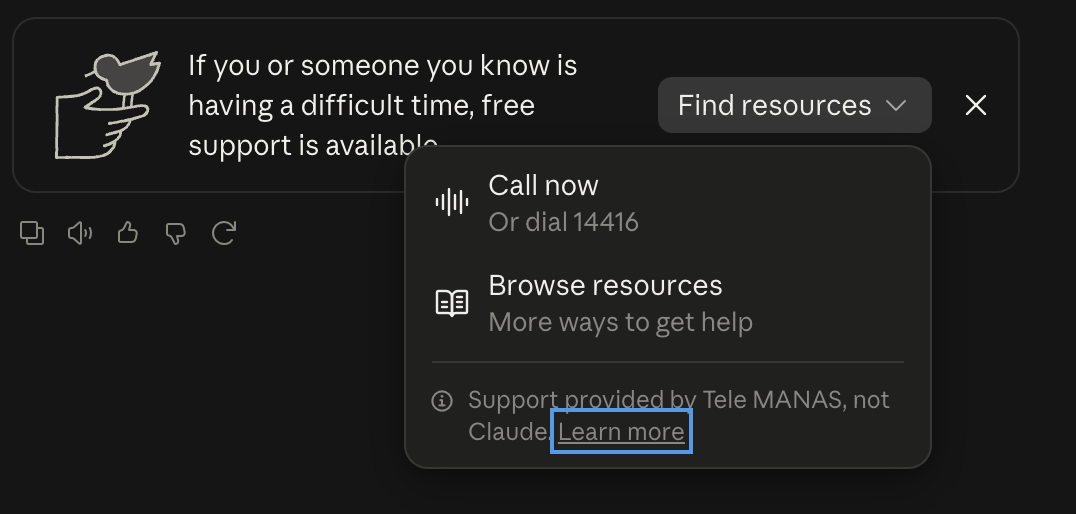
Anthropic (from the greek anthropos = human) started something humanistic. Sonnet 5.5, one of their latest models, has mental health guardrails. If you ask it something about mental health, it gives you resources, and encourages you to contact a crisis hotline or look for a provider in case there is crisis. Its not perfect, but it is a step in the right direction. Anthropic has faced scrutiny for being overly sensitive, sometimes misinterpreting deep or philosophical user prompts as signs of mental distress (per reports on Reddit) - but I’m ok with leaning too far in that direction.
💌 As always, thanks for reading. Get in touch and let me know your thoughts!
Thank you for joining us on this adventure. Stay tuned for more AI insights, best practices, and more future editions of AI+MedEd.
For education and innovation,
Karim
Share this with someone, have them sign up here.