

Educators in Medicine,
In this newsletter, we continue our journey through the fundamentals of AI, its applications in medicine, and its transformative role in faculty development and education. Let’s dive into learning.
When I was a student and resident, my white coat pockets were heavy. A pocket pharmacopoeia, an antibiotic guide, a journal with notes, and a pen that never worked when I needed it. We carried our references because we couldn’t carry everything in our heads.
My residents’ pockets are lighter now. They just carry a phone.
Three stories crossed my desk recently that show how much that phone is changing what we look up, what we teach, and what we prescribe.
📊 1: What Clinicians Actually Ask AI
JAMA just published a cross-sectional study by Vishal Patel and colleagues at OpenEvidence on how U.S. clinicians use OpenEvidence: Clinician Use of an Artificial Intelligence-Enabled Clinical Information Platform.
The scale is hard to ignore. From January 2024 to June 2026:
About 952,000 clinicians submitted about 271 million queries.
Monthly active users grew from 355 to about 703,000.
In June 2026, 92.5% of active users were returning users. Their people come back! This is how many tools are graded - and OE does pretty well.
Our learners are the power users. Relative to their share of the workforce, the heaviest physician users were those within a decade of graduation, followed by residents and fellows. Family medicine ranked among the top three specialties, behind oncology/hematology and internal medicine. If you haven’t asked your residents whether they use it, ask.
They ask about treatment. About half of queries sought help with clinical decisions. Treatment and management (33%) and medication information (14%) led the way. Diagnosis was about 14%. Yet most AI benchmarks, and a lot of our teaching and testing, focus on diagnostic reasoning. The authors call for evaluating AI on the treatment and medication decisions clinicians ask about. I’d say the same about how we assess our learners.
They ask outside their lane. Physicians frequently asked about topics outside their own specialty, from about a third of queries among oncologists to nearly 9 in 10 among emergency physicians. Family medicine lives at those borders every day. I think this is totally expected - maybe even encouraged? I believe this sort of access helps keep generalists broad scope.
The authors describe this as a shift from recall to retrieval, how clinicians access knowledge. If knowledge is shifting from recall to retrieval, then retrieval is a clinical skill now? Should we teach and assess it like one? On rounds, try these questions: What did you prompt? What did it cite?
Authors are affiliated with OpenEvidence, which provided the data. That doesn’t make the findings wrong, but it’s worth reading with that in mind.
🏥 2: Johns Hopkins and OpenEvidence Rethink Training
So we know our learners are already using OpenEvidence, at scale, every day. And the numbers keep climbing: by September, the company reported 1.12 million verified U.S. clinicians on the platform. The real question for academic medicine is what we do about it.
Johns Hopkins just gave one answer. On October 13, Johns Hopkins Medicine announced a partnership with OpenEvidence to bring AI into both medical education and clinical care. Read the full story here: Johns Hopkins Medicine taps OpenEvidence to bring AI into medical education, clinical care.
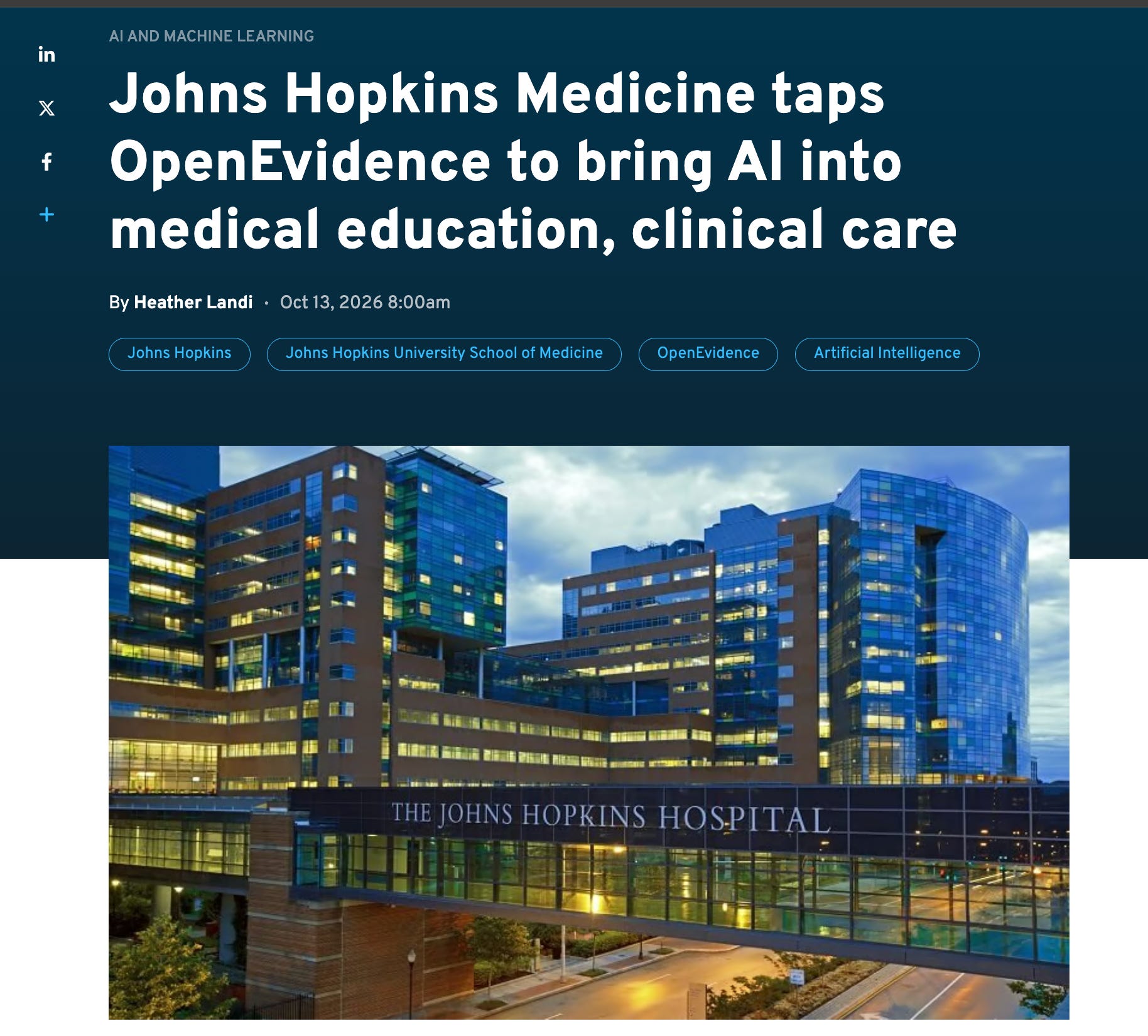
On the clinical side, the reported goal is “human-first AI systems” that combine the best available evidence with a patient’s history and Hopkins’ own clinical best practices. Sara Murray, Hopkins’ chief medical informatics and AI officer, emphasized identifying high-impact use cases and rigorously evaluating the impact on clinical decisions, quality, and patient outcomes. They’re still early in defining exactly what they’ll build.
On the education side, Sanjay Desai, Vice Dean for Education, framed the question I keep coming back to in these blogs. Which competencies can we offload to AI? Which will physicians do augmented by AI? Which are inherently human - and should stay that way? And for the competencies that must stay with the physician, how do we protect against cognitive offloading? His worry is the one every program director shares, myself the same: a physician who finishes training and enters unsupervised practice without the skills we hope them to have.
The new model will emphasize core skills: pathophysiology, evidence-based medicine, clinical reasoning, diagnosis, and patient communication. Desai also sees AI personalizing training: tracking which clinical experiences a learner has had, identifying gaps, filling them with simulation, flagging learners who need support, and helping move from time-based to competency-based training. He even said AI can bring “the joy back” to learning, making it efficient and fun. (You won’t find me arguing with that one.)
My reflections:
Hopkins is asking good questions. Offload, augment, or keep human is a useful framework. I like it for curriculum design in the AI era. I’d add one more thing: our assessments have to keep up with our tools.
Keep the evaluation independent. OpenEvidence’s CEO didn’t disclose commercial terms, calling it “at minimum a research and development and product collaboration.” Hopkins describes OpenEvidence as an example of the tools physicians will use, not the tool that dictates its model. Thats tough to see where the lines are going to be drawn.
Back to the bedside. Hopkins built the bedside model of training more than a century ago. Desai says AI “invites us back to the bedside.” That’s the hope…I guess? But if we lean too far, and let the phone handle all retrieval, is there a ledge we can fall off?
💊 3: Epic Shows Us the Price Tag
In clinic, the very next question after a new med comes up, usually comes from the patient: can I afford it?
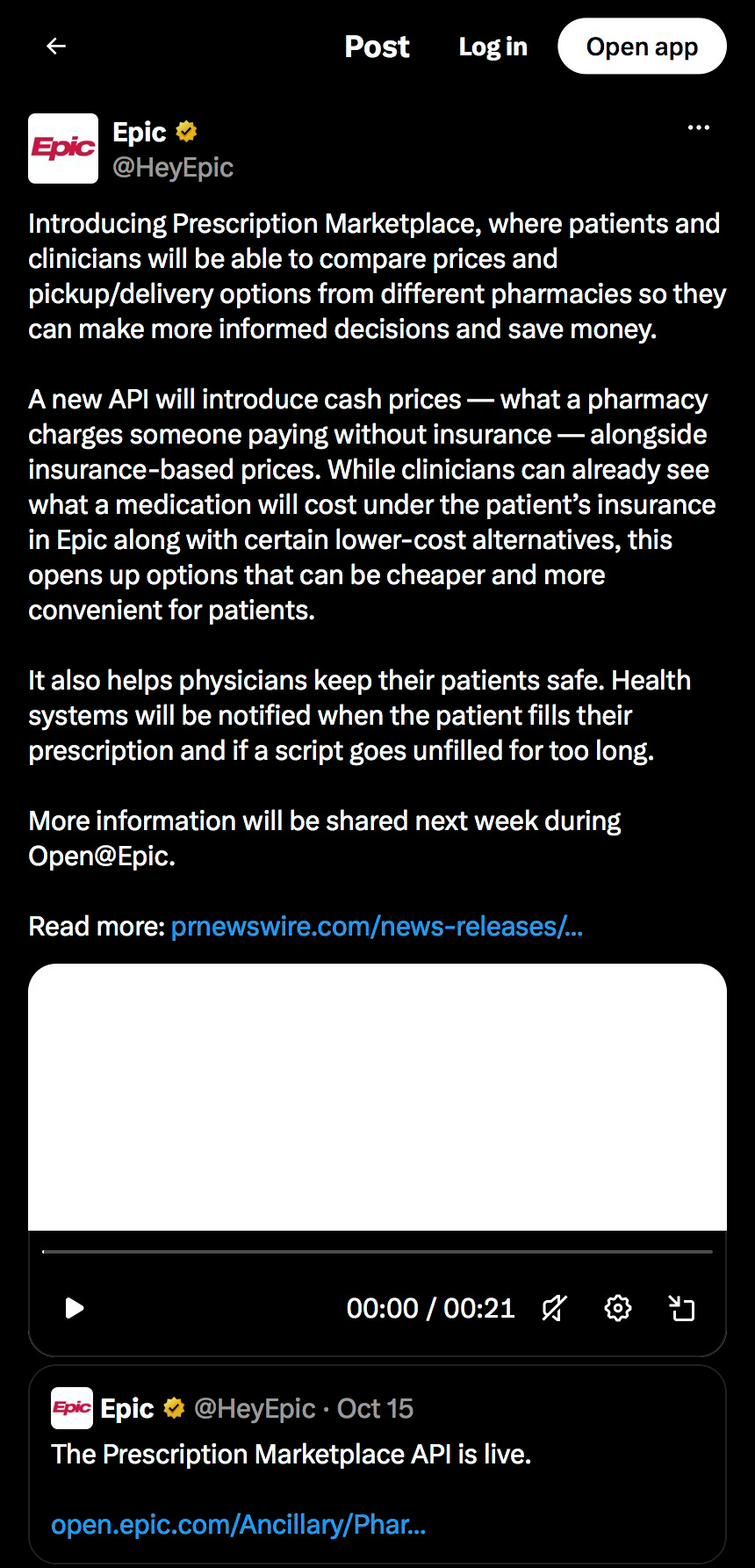
Epic announced Prescription Marketplace, which will let patients and clinicians compare prices and pickup or delivery options across pharmacies. A new API brings in cash prices (what a pharmacy charges someone paying without insurance) alongside the insurance-based prices we can already see in Epic. Epic says the API is live now, and the feature releases to health systems in summer 2027. Amazon Pharmacy, Mark Cuban Cost Plus Drugs, Costco, and LillyDirect are among the early participants.
The part I’m most excited about besides the price is the fill notifications. Health systems will be notified when a patient fills a prescription, and when a prescription goes unfilled for too long. This will help decisions in the office visit.
Every doctor knows the interaction where diabetes or blood pressure is “uncontrolled on three medications” and then we learn medication was never picked up. A prescription that never leaves the pharmacy is a painful delay in addressing needs. Cost is often the reason, and too often we find out months later.
Not long ago, I wrote a letter to Epic asking why evidence takes so long to reach the point of order. It turns out the price got there first. I’ll take it. Cost is a big part of the conversation, and now no more need to fumble around with GoodRx mid visit.
Two wishes as this rolls out:
Teach it. Cost conversations are a clinical skill. “How do you feel about this price?” belongs in the prescribing encounter, and students+residents should practice asking it just like they practice taking a history.
Route it. Fill notifications are great data. They are also new In Basket messages. Before summer 2027, decide who receives them and what happens next.
My white coat pockets are lighter than they were in residency. My responsibility isn’t. Our learners can retrieve almost anything now. Our job is to make sure they know what to do with it, what it costs the patient, and when to put the phone down and look up.
💌 As always, thanks for reading. Get in touch and let me know your thoughts!
Thank you for joining us on this adventure. Stay tuned for more AI insights, best practices, and more future editions of AI+MedEd.
For education and innovation,
Karim
Share this with someone, have them sign up here.