

Educators in Medicine,
In this newsletter, we continue our journey through the fundamentals of AI, its applications in medicine, and its transformative role in faculty development and education. Let’s dive into learning.
Finally, a shared language
This is a special edition! On October 27 the AAMC published AI Competencies Across the Learning Continuum (there is also a summary PDF), and medical education finally has a shared map for AI. For two years every program, including mine, has been teaching AI on instinct. Some banned it, some ignored it, and some handed learners access and hoped for the best.
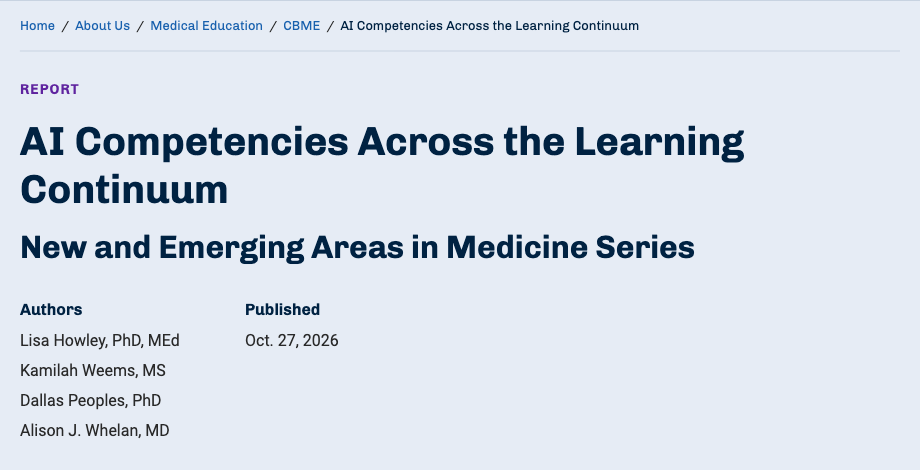
The report, from the AAMC’s New and Emerging Areas in Medicine Series. Source: AAMC.
I train family medicine residents and I build learning tools. My residents already use AI on every shift: to draft notes, check a dose, build a differential. The question was whether we would teach them to use it well, and how we would know they could.
This framework gives us the words to answer that. Here is what it says, what I think it gets right, and what we built on top of it this week.
What the AAMC published
The framework has 26 competencies in six domains, and each one is written at three tiers: 78 statements in all. If you have read the ACGME core competencies, the six domains will feel familiar.
I. AI Knowledge for Practice. What AI is, how it works, how to prompt it and how to check what it says.
II. AI-Assisted Patient Care and Clinical Reasoning. Using AI to support, not replace, clinical judgment.
III. Communicating About AI and Interprofessional Collaboration. Talking with patients and teams about the AI in their care.
IV. Professionalism and Ethics. Privacy, disclosure, accountability and bias.
V. Practice-Based AI Learning and Improvement. Learning with AI without losing the skills it can replace.
VI. Systems-Based AI Practice. Governance, safety and how AI fits the health system.
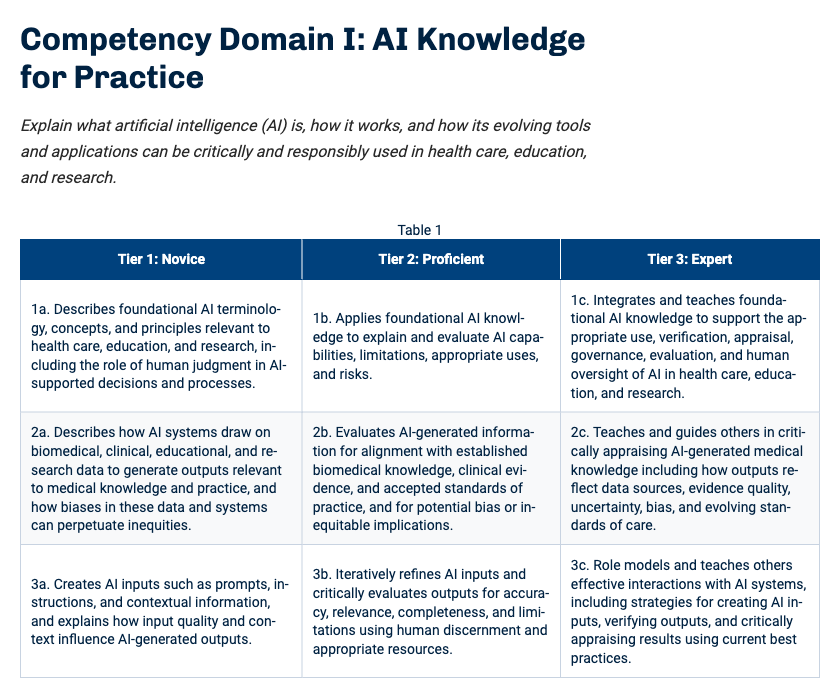
Domain I, Table 1. Source: AAMC report page.
The three tiers are Novice, Proficient and Expert. The AAMC is explicit that they are “not intended to correspond directly to medical student, resident, or faculty roles.” A faculty can be a Novice (yes, including all of us). A second-year student who builds tools on weekends may already be Proficient. The report also says the Expert tier “may not be aspired to by all,” which I appreciate. Not every clinician needs to lead AI governance.
The AAMC calls the work “an educational framework, an invitation, and a historical marker” and “a snapshot of our collective thinking at this moment in time.”
I think they will eventually change, but a good first shot.
The AAMC treats verification as a core skill. Over and over, the statements ask learners to check AI output against evidence, standards of care and their own judgment. That is the critical thinking I worry about most.
It names deskilling. Domain V asks us to learn with AI without letting it hollow out what we know. Every program director I talk to has felt this. It even names “never-skilling,” the skills a learner never builds because the tool was always there. Now it is a competency.
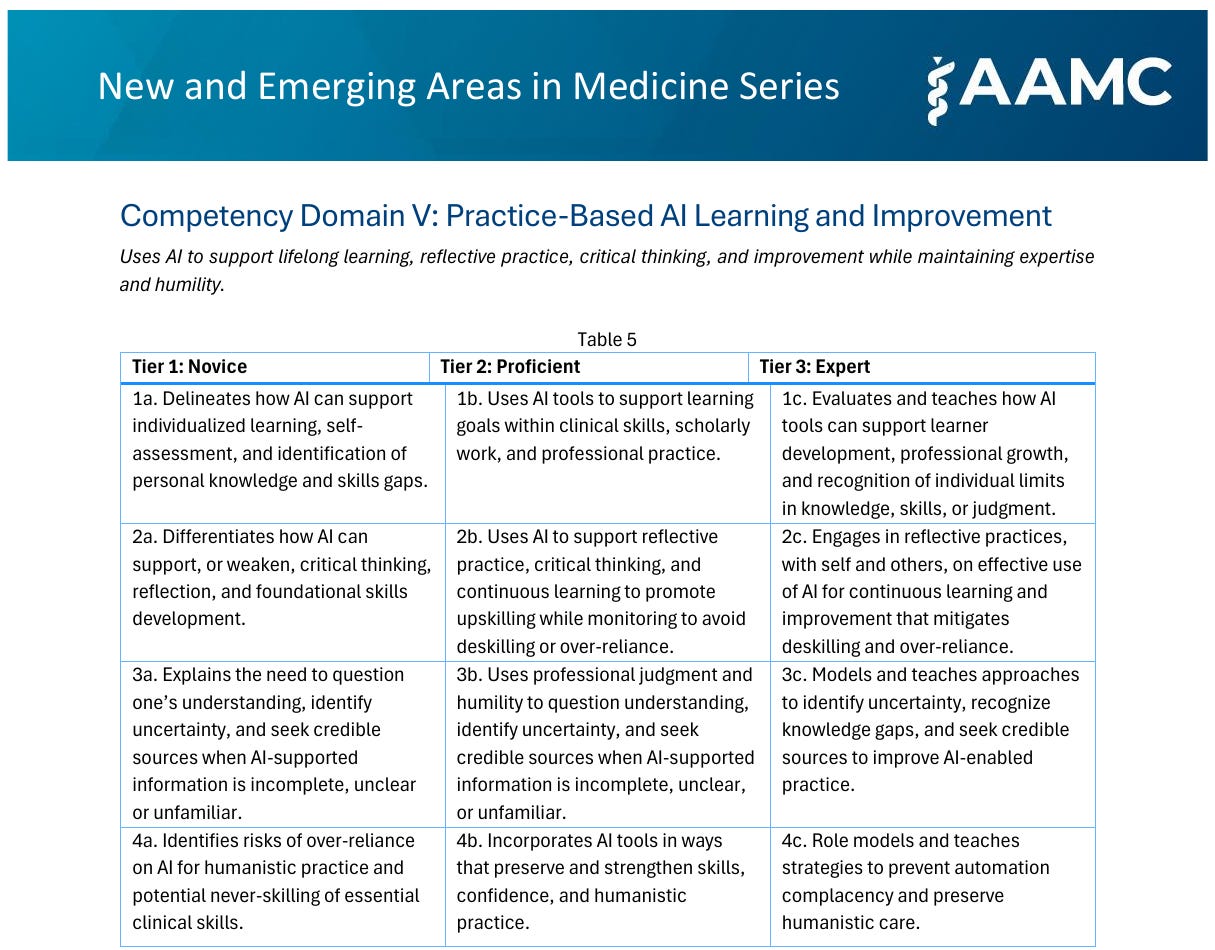
Table 5. Source: AAMC summary PDF, page 5.
What it leaves to programs is assessment. A competency is a claim about what someone can do. The framework tells us what to look for. It does not tell us how to see it. A multiple-choice test can show that a resident knows what a hallucination is. It cannot show that she catches one at 2 AM.
THE BIG ANNOUNCEMENT!!!!
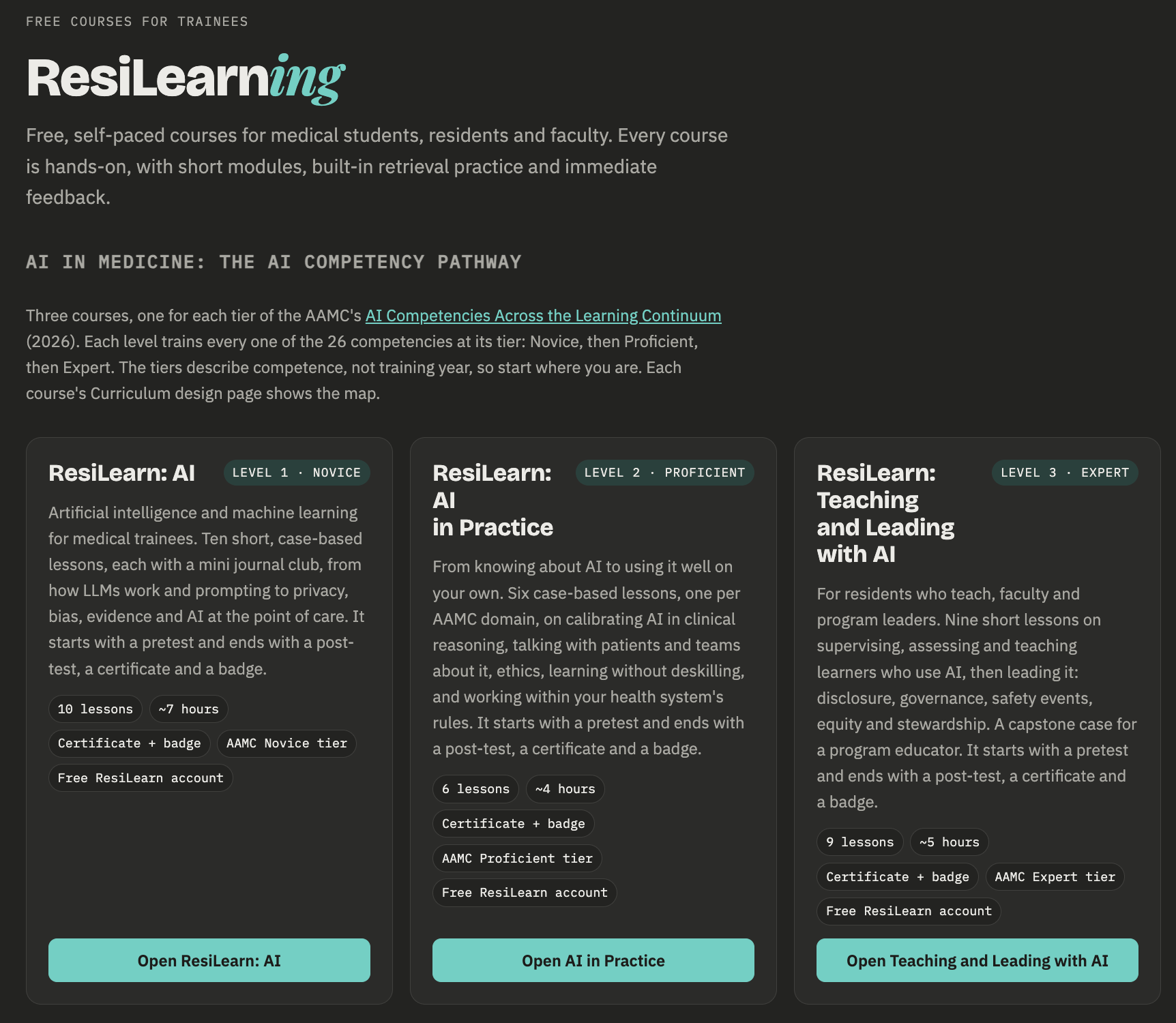
People have been asking for a very long time for a tool to track/give to the trainees and faculty for asynchronous AI training. Now you can do that, and watch them level up, and track it. ResiLearning built a free AI pathway with one course per tier, each mapped to all 26 competencies at its level.
Level 1: ResiLearn: AI. AAMC Novice tier, all 26 competencies. 10 lessons, about 5 hours.
Level 2: ResiLearn: AI in Practice. AAMC Proficient tier, all 26 competencies. 6 lessons (one per domain) and a capstone, about 3.5 hours.
Level 3: ResiLearn: Teaching and Leading with AI. AAMC Expert tier, all 26 competencies. 9 lessons and a capstone, about 5 hours.
Every lesson follows the same rhythm: a warm-up, a short teaching section, cases about real learners using AI, a mini journal club with two papers and a check with feedback. The cases are the point. A PGY-2 on urgent care gets a confident chatbot answer that calls a diabetic woman’s exertional jaw pain “atypical” and suggests reassurance. What do you do next?
Levels 2 and 3 add live exercises. Learners do the real task with a real tool, then record what they did, what the AI got wrong and how they caught it, with a named reviewer. That record prints as a portfolio page. This is my answer to the assessment gap.
Each course starts with a pretest and ends with a post-test, a certificate and a badge. Learners can send the certificate straight to their program director as a PDF. Learners take an optional retest at eight weeks, to see what stuck.
What you can do Monday morning
Read the six domain headings with your faculty. 10 minutes at a faculty meeting. Ask who on your team is a Novice.
Run a gap analysis. The AAMC lists this as a first use. Hold your current curriculum against the 26 competencies and mark what you already teach.
Start where your learners are, not where their PGY year says they are. Have them take a pretest and pick a level from the result.
Sign up your learners, and faculty for our asynchronous course! The whole pathway is at resilearn.com/resilearning. It is free, it takes an afternoon to try, and I would love to hear what your students, residents and faculty think.
The AAMC called this framework an invitation. Let’s take them up on it.
💌 As always, thanks for reading. Get in touch and let me know your thoughts!
Thank you for joining us on this adventure. Stay tuned for more AI insights, best practices, and more future editions of AI+MedEd.
For education and innovation,
Karim
Share this with someone, have them sign up here.
Sources
AAMC. AI Competencies Across the Learning Continuum. Howley L, Weems K, Peoples D, Whelan AJ. AAMC New and Emerging Areas in Medicine Series; Oct. 27, 2026. (Summary PDF)