
Episode 05
Generative, JAMA, & Data Breaches

Educators in Medicine,
In this newsletter, we continue our journey through the fundamentals of AI, its applications in medicine, and its transformative role in faculty development and education. Let’s jump into learning.
1. AI 101 - A Primer on Artificial Intelligence
Last episode, we started learning about the basics of HOW some things in AI work. Today, I want to turn our attention to the details of large language models (LLMs) in order to take full advantage of these tools.
Recall and Generating Text
Everyone has that friend who had the photographic memory in medical school, and could effortlessly identify an enzyme, or a mechanism of action by just jumping to the page in their brain. Well, the LLM's superpower is its ability to recall information and then generate text that you and I can understand. It remembers what it has read during training, which in ChatGPT, for example, includes a vast range of texts from the internet. When you ask it a question or give it a prompt, it sifts through this vast knowledge and generates a response.
For instance, if you ask, "How does gluconeogenesis work?" The LLM remembers reading about gluconeogenesis and can generate an explanation based on that stored knowledge. But how does it create a different answer every time I ask? Well, that is the generative capacity these LLMs are known for.
Generative AI
Generative AI is the key aspect of LLMs, and what has boosted their popularity of late. This means LLMs can not only answer questions but also create new content. It's like having an AI author. For example, if you ask it to "Write a case about a patient who got scratched by a cat," it can invent a story on the spot.
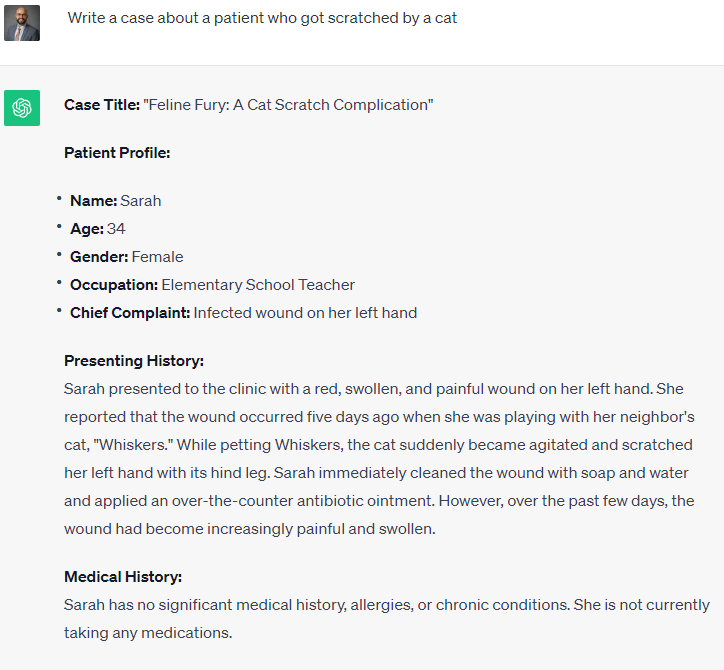
It’s fun to see that the LLM can even use puns, alliteration and wit. I did not ask for much, but it continued to write out an entire scenario.
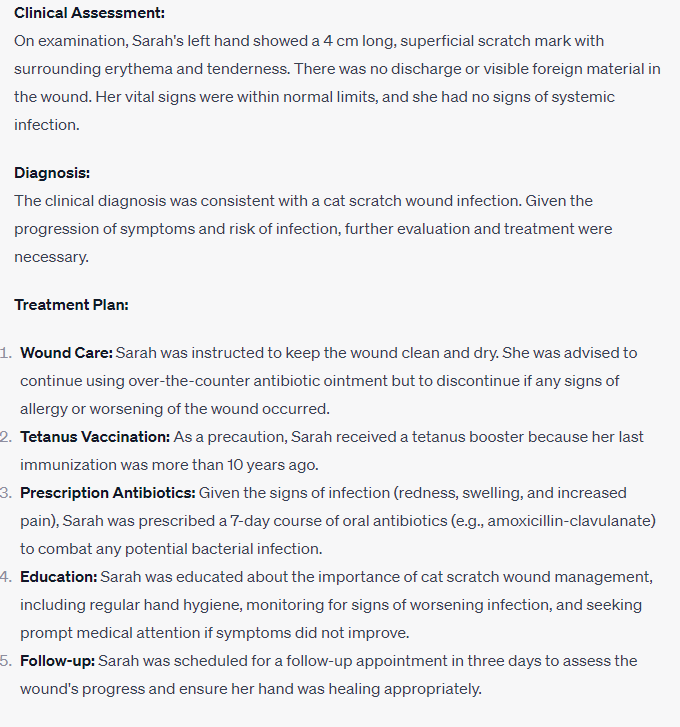
Using a text generator for a curricular development project allows the LLM to create a well written case. You can then use it as a starting point to expedite your work, flexing its understanding of language and the creativity it's learned from the texts it's been trained on.
I want to encourage you to download the ChatGPT application, too. They just announced they are starting soon to allow photo and audio access. Essentially, you can take a photo of your bike, and ask it to walk you through how to change its tire. Pretty fascinating that now the model which we taught to ‘remember’, can ‘see’ and ‘listen’. I challenge you to start thinking of applications for these new skills. Let me know what you think of here!
2. AI in Education - Empowering Faculty Development
I want to share with you a video that was put out by JAMA interviewing the Chief Clinical Officer at Google about incorporating AI in healthcare. It is worth sharing with your faculty and clinical team! He reminded us that AI should have a positive impact with clinicians. Like we mentioned above, the models are coming to understand, communicate, and adjust language much more than before. He related it to penicillin coming out while being in medical practice - it was a game changer! The video serves as a nice high-level summary of how AI will impact healthcare.
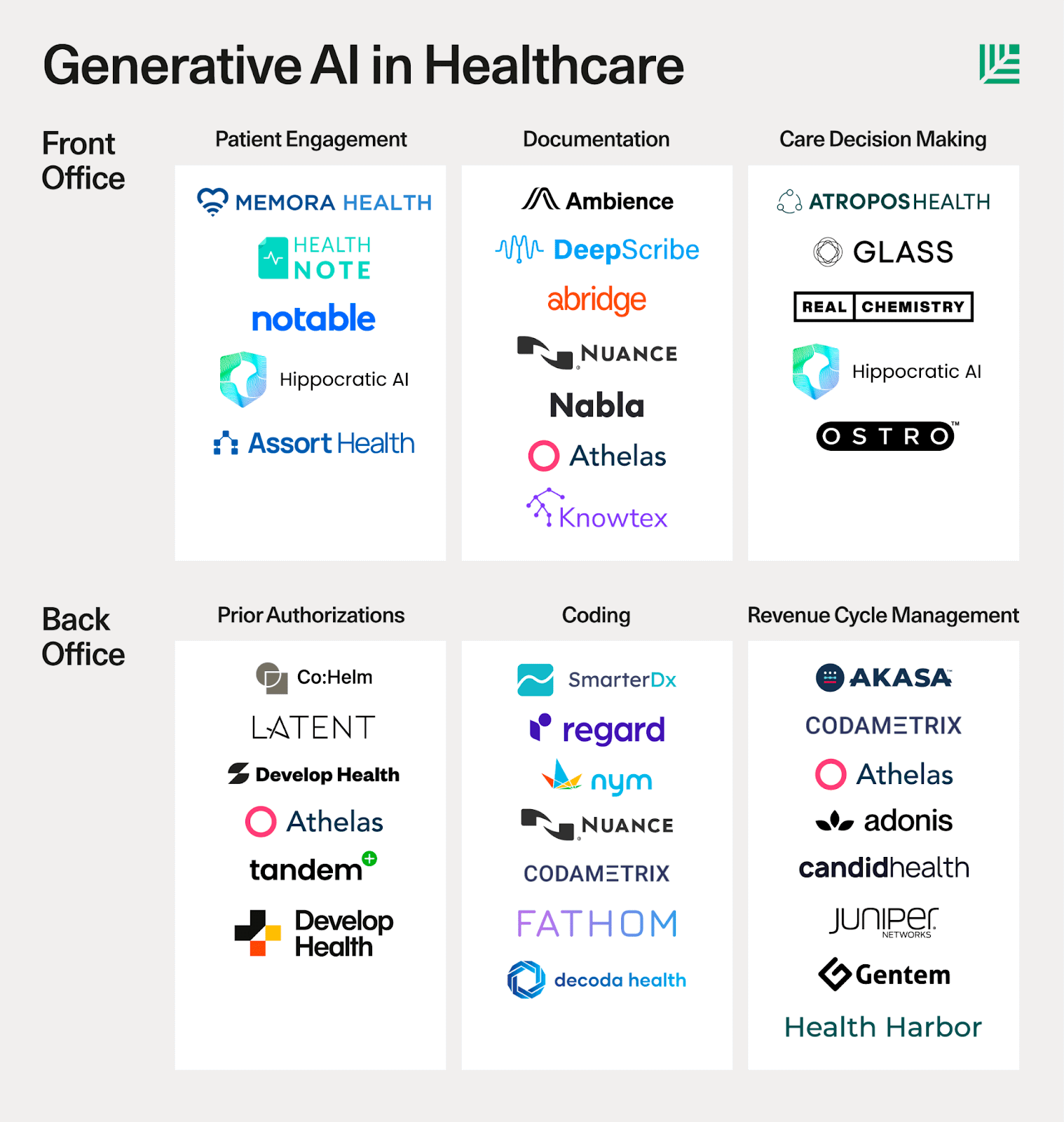
They highlight AI tools to offload administrative tasks, and act as an assistive tool. I found this article that had a great graphic (below) showing which AI tools are currently tapping into the different scenes in clinical practice. There are several options in each space. As the LLMs will improve, the tools will be more proficient.
The interview reminds us to keep mindful of automation bias - just because it comes from a machine, does not make it correct! And like we’ve discussed before, we should continue to question what is brought about as ‘answers’ to our queries. We must stay vigilant.
3. What can I do now?
For you and your trainees, ChatGPT can assist interpreting results. I had a patient message asking about the results of his PFTs. The test was performed, but there was no formal result yet in the EMR. I took the deidentified PFTs, and asked ChatGPT to interpret them and write a note to the patient. It did a phenomenal job concluding there was no obstructive process. I did have to cut out some medical jargon, but it did a good job of interpreting the data for the patient.
Lastly, if you’re a Google user, sign up for Bard! There was a recent update announced that Bard now can be used to answer questions about your emails, and fact check what you write on the fly. Imagine your own writing as the training model for Bard, so it can answer questions based on your own information. Like - “when was my last trip west of the Mississippi, and what did I eat out there?”
I’ll close out with a sad announcement: A strange occurrence happened this week for us in my health system - Hanna General Hospital - has officially blocked ChatGPT from its servers. I was pretty disappointed, even reached out to our IT folks and asked why. They said there was concern about patient data breaches…
In my opinion, patient data can be compromised in many other ways with that thing called the internet, but what do I know? We’ll see - there’s supposed to be an internal, HIPAA compliant version of Bing that we’ll be able to use. It's not up yet, but I’ll keep you updated with what happens. I wonder if this will cause a movement across the country to block the use of ChatGPT? Is your health system still allowing it?
Thank you for joining us on this adventure. Stay tuned for more AI insights, best practices, and more future editions of AI+MedEd.
For education and innovation,
Karim
Share this with your colleagues - have them sign up here.